[Case Study] Sports Traffic From Telegram: $3 510 in One Football Season


Just when you think there’s nothing new left to invent in sports traffic monetization, there’s always a publisher who finds a fresh way to use well-known tools.
So, what does it take? Our publisher, who is only 19, by the way, has already discovered a working formula: passion for the topic, plenty of testing, and a solid social strategy.
Let’s dissect his success story and get inspired.
Contents
hide
How it all started
Our publisher, Tom, runs a sports website targeting Middle Eastern audiences. We asked him why he decided to enter the sports niche, which is extremely competitive, to be quite honest. And, as it turns out, it happened in the most natural way possible:
“Football has always been my biggest passion. Around a year and a half ago, I started creating football-related content on Telegram simply because I enjoyed sharing news and updates with other fans. At first, it was just a hobby, but as my audience grew, I realized there was an opportunity to build something bigger. That’s when I decided to launch my website and create a complete platform for football fans.”
Fast forward, now Tom has one football website and four Telegram channels. But he’s not working alone – he has two teammates. Quite fitting for someone who lives and breathes football:
“My two teammates also own four additional football channels. Together, our network reaches approximately 700,000 followers.”
Our publisher explained that he’s been using the Telegram-to-website model for about a year and a half, with the website gradually becoming the project’s main focus.

What Tom posts in his channels
The content itself is pretty straightforward. Tom doesn’t try to invent new formats – he simply gives football fans the information they come looking for:
“Our channels focus on football news, match schedules, statistics, team updates, transfer news, and real-time information during major football events. Users visit the website because it offers more detailed content in one place, making it easier to follow everything related to football.”
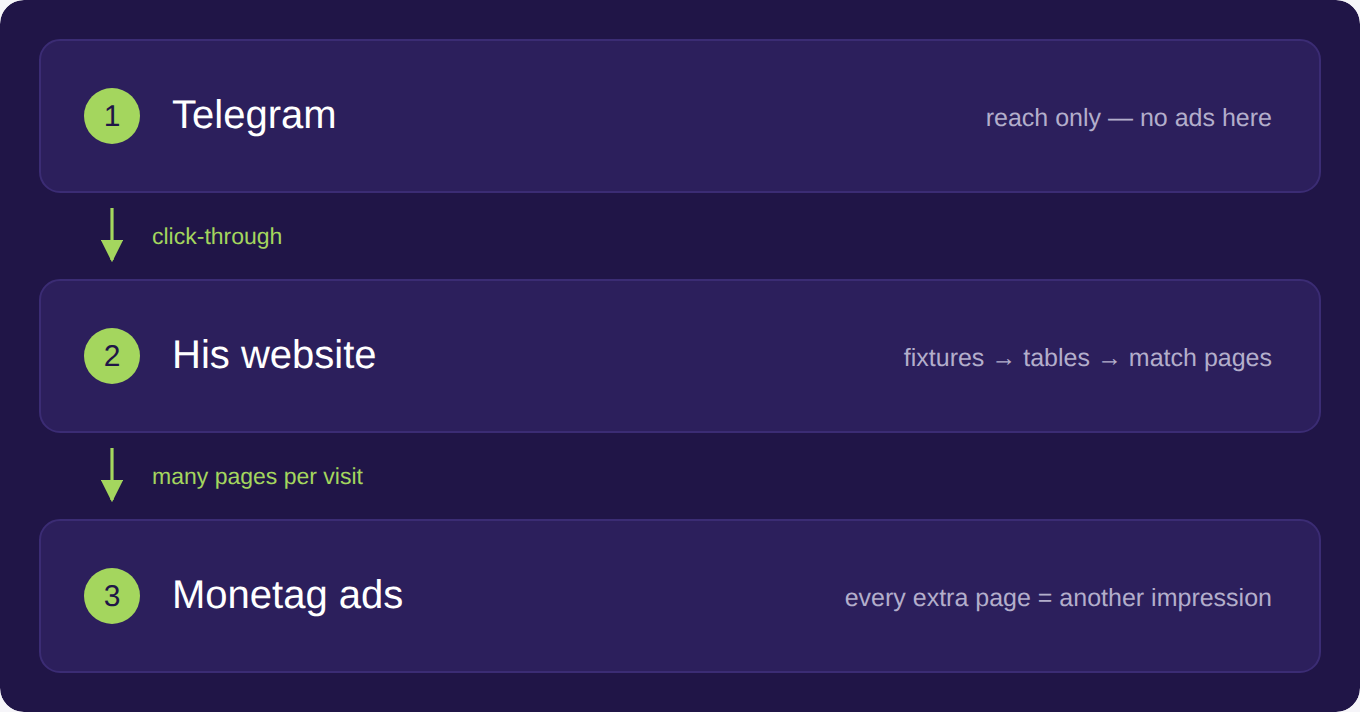
The way the work is divided between Telegram and the website is what makes this model tick: Telegram brings in the audience, while the website turns that traffic into revenue.
The channels provide reach, and the website handles monetization. Instead of trying to make money directly from Telegram, Tom uses it to send readers to a platform he fully controls.
“Users first discover our content through Telegram. They click through to our website to read more detailed information, browse match schedules, statistics, and football updates. As they continue navigating different pages, Monetag ads are displayed naturally, creating a smooth monetization flow without disrupting the user experience.”
That last part matters more than it sounds. A football fan checking a fixture list doesn’t land on one page and bounce: he clicks through schedules, tables, match pages.
Every extra click is another monetization opportunity, which is exactly why this niche rewards depth of content over one-off viral posts.
And Then Came the World Cup
The World Cup changed the numbers dramatically:
“The FIFA World Cup was the biggest driver. During major tournaments, football fans actively search for news, schedules, statistics, and updates. Interest naturally increases, bringing significantly more visitors to both our Telegram channels and website.”
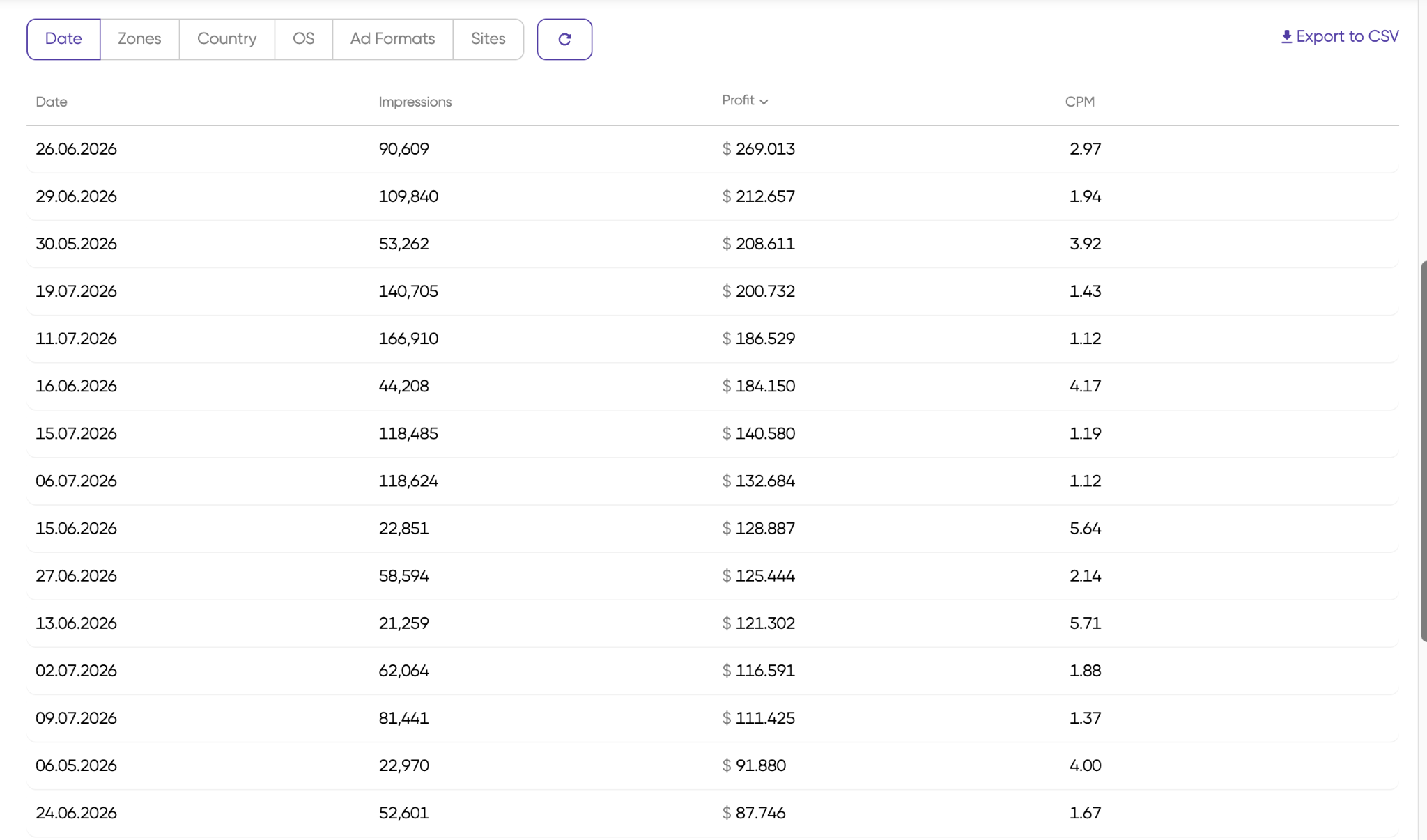
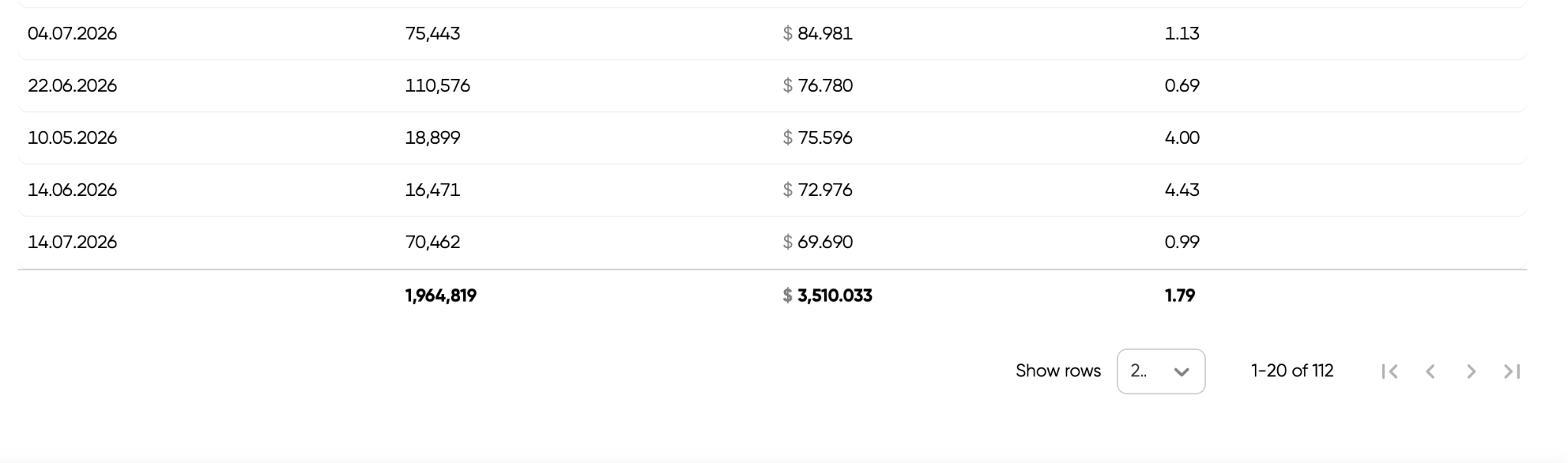
(Daily stats, sorted by profit)
Here’s what that looked like in numbers. Over the full 112-day period: from May 1 to August 20, 2026, Tom earned $3,510 from 1.96 million impressions, with an average CPM of $1.79.
| Period | Revenue | Share of the season |
| June + July (the World Cup months) | $2 986 | 85% |
| May (pre-tournament) | $513 | 15% |
| 1–20 August (post-tournament) | $11 | 0.3% |
His August profits are affected by the current website revamp to prepare for the new season.
Tom’s most profitable day wasn’t the final, or even a knockout match. On June 26, during the group stage, he earned $269.01 from 90,609 impressions at a $2.97 CPM. With several matches taking place on the same day, fans kept returning to check schedules and updates throughout the evening.
The final on July 19 generated 140,705 impressions and $200.73. Tom also reported around 90,000 visitors that day, making it one of his strongest traffic days ever.
Tom explains what his team did during the tournament:
“We knew major football tournaments would attract more interest, so we prepared by publishing more frequently, keeping our content updated, and coordinating with our Telegram network to ensure users always had fresh information available.”
So yes, the World Cup brought the audience. But for 39 days, three people still had to keep eight channels full of fresh, accurate, and to-the-point information, and give those fans a reason to visit the website.

One format did 86% of the work
We asked Tom what he’s running. His answer was short:
“We mainly use Popunder. During high-traffic days, this format consistently delivered the best balance between user experience and revenue.”
The dashboard agrees, emphatically.
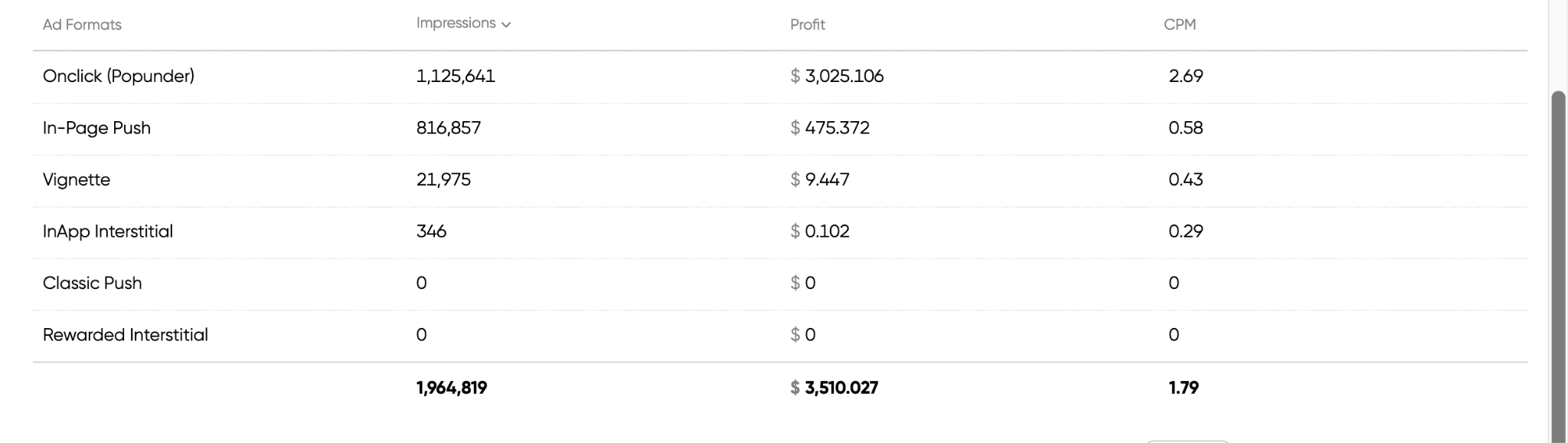
Popunder accounted for 57% of the impressions and 86% of the revenue, which makes complete sense for this audience.
During a live event, a football fan usually arrives with one task: check the fixture or find the score. Popunder monetizes that short visit early, before the user leaves.
In-Page Push covered a different part of the session: the schedule and match pages users opened after the popunder had already fired. That brought in another $475 on top of the Popunder revenue.
The two formats weren’t competing for the same impression: they were working at different points in the same visit.
More traffic didn’t mean a higher CPM
Tom’s stats reveal an interesting pattern: his highest-CPM days were nowhere near his highest-traffic days.
And this isn’t an off-season-versus-tournament story – both of his best CPM days fell inside the World Cup.
The tournament ran 11 June – 19 July: group stage to 27 June, knockouts from 28 June.
| Date | Stage | Impressions | Revenue | CPM |
| 6 May | Before the tournament | 22 970 | $91.88 | $4.00 |
| 30 May | Before the tournament | 53 262 | $208.61 | $3.92 |
| 13 June | Group stage | 21 259 | $121.30 | $5.71 |
| 16 June | Group stage | 44 208 | $184.15 | $4.17 |
| 22 June | Group stage | 110 576 | $76.78 | $0.69 |
| 26 June | Group stage | 90 609 | $269.01 | $2.97 |
| 11 July | Knockouts | 166 910 | $186.53 | $1.12 |
| 19 July | Final | 140 705 | $200.73 | $1.43 |
The pattern holds even when we compare days from the same stage of the tournament. On June 13, Tom received 21K impressions at a $5.71 CPM. On June 22, he received 111K at $0.69 – 5 times the traffic and slightly less revenue.
The same thing happened on two other group-stage days. June 16 brought 44K impressions at a $4.17 CPM, while June 26 brought 91K at $2.97. Traffic doubled, CPM dropped by almost a third, and revenue increased by nearly half.
So volume isn’t automatically good or bad news.

What changes is the mix of people behind it. On a typical day, Tom’s traffic comes mostly from regular readers in his best-paying market. During a major match, visitors arrive from a much wider range of geos, and the difference in rates is steep: Saudi Arabia brings a $2.21 CPM, compared with $0.35 for Egypt.
As more traffic shifts toward the lower-paying end, the blended CPM falls even though the setup remains the same.
Live matches also give fans more reasons to move between schedules, statistics, and match pages. As a result, a larger share of the day’s impressions may come later in the same session rather than from a user’s first page view.
None of this means peaks should be avoided. June 26 was Tom’s most profitable day of the season, bringing in $269 despite a CPM being below his highest.
The practical lesson is to compare CPM across days with similar traffic volumes—and judge peak days by total revenue. If impressions triple while CPM halves, revenue still grows by 50%.
Where the money actually came from
Tom’s traffic came mainly from the Middle East, with some visitors from Europe as well. Here’s how impressions, revenue, and CPM were distributed across the top countries:
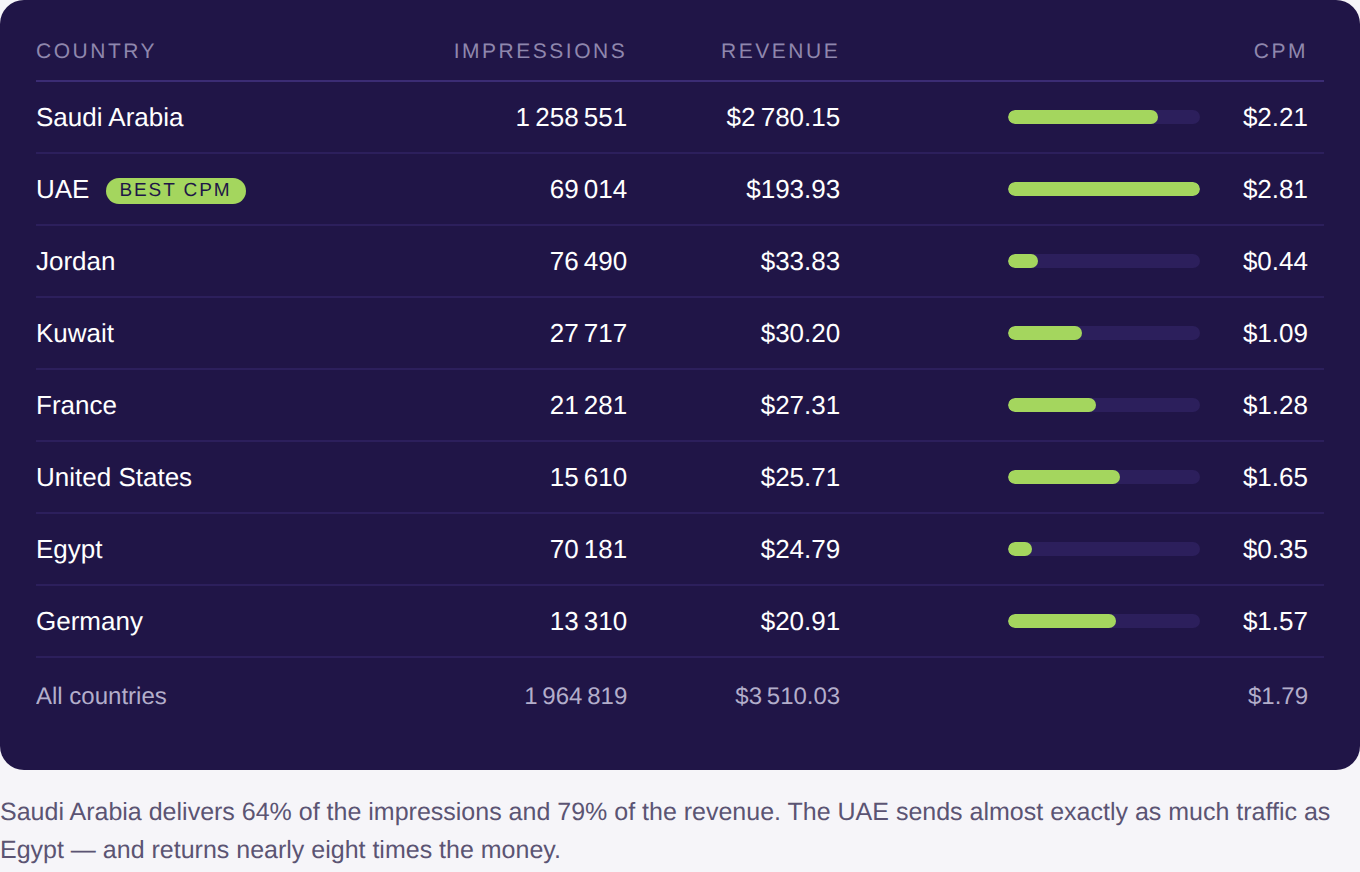
Three things stand out:
- Saudi Arabia dominates the results: 64% of impressions and 79% of revenue came from this one market.
- The UAE brought the most valuable traffic. Its 69K impressions were 18 times lower than Saudi Arabia’s, but its $2.81 CPM was the highest in the account. Growing the UAE share could raise Tom’s blended CPM even without a major increase in total traffic.
- Traffic volume and traffic value follow different patterns. Egypt brought 70K at $0.35. Jordan and Algeria also contributed traffic, but relatively little revenue.
Saudi Arabia, together with the UAE, the top two markets, accounted for 85%, so future traffic growth should be planned country by country, not for one broad “Arabic-speaking” audience.

Is this repeatable, or was it just a World Cup?
Part of the result was specific to the World Cup. But the audience Tom gained during the tournament didn’t simply disappear when it ended:
“Although traffic naturally increases during major tournaments, our audience continues growing after every event. Every tournament brings new visitors who later become regular users, so each football season helps us build a larger long-term audience.”
Traffic drops after a tournament, but some of the new visitors stay, follow the channels, and return to the website. So when the next major event begins, Tom won’t be starting from zero – he’ll already have a larger audience.
Why Tom chose Monetag
Monetag wasn’t the first ad network Tom worked with:
“Before Monetag, I tried several advertising networks. While they generated some revenue, I wasn’t completely satisfied with their dashboards, reporting, or support. Monetag stood out because of its clean interface, transparent reporting, and responsive account management… campaign recommendations that helped improve my results. That’s why I decided to stay with Monetag.”
Five things Tom did right
Tom’s exact setup won’t work for every niche, but the approach behind it is easy to adapt:
- Build your audience where people already spend time, then bring them to a platform you control. Telegram gave Tom reach; his website gave readers more content and created the revenue.
- Choose a topic you genuinely understand. Tom knows what football fans look for on a match night because he’s one of them.
- Give readers a reason to open more than one page. Schedules, tables, statistics, and match updates kept visitors moving through the website instead of leaving after one post.
- Test formats on your own traffic. Tom used several formats together to see which ones performed best with his audience.
- Prepare for the dates that matter. The World Cup schedule was known months in advance, so the team increased its publishing frequency during the tournament. June and July generated 85% of the season’s revenue.
Tom started by sharing football updates on Telegram simply because he enjoyed it. A year and a half later, that audience helped his website earn $3,510 in one football season.
He now knows which countries, formats, and tournament days bring in the most revenue. When the next big event arrives, he won’t be guessing.
Want to monetize your own niche audience?
Estimated reading time: 8 minutes