Monetag: How Telegram Channel Networks Are Becoming the New Media Empires in 2026

Telegram is one of the few platforms where publishers can still get strong organic reach without depending entirely on algorithms.
The scale of Telegram is hard to ignore…
In 2026, researchers studying more than 712,000 public channels and groups highlighted just how large and interconnected the platform has become.
Instead of building a single community, publishers are creating entire ecosystems of interconnected channels that redistribute traffic, retain audiences longer, and generate revenue both inside Telegram and on external websites. For publishers, affiliates, and media buyers, Telegram is becoming far more than a messenger app as it’s turning into a full-scale traffic and monetization ecosystem.
So how exactly do these Telegram ecosystems work, and why are so many publishers rushing to build them right now?
Inside the Telegram Network Strategy: How Publishers Scale
A few years ago, most Telegram publishers focused on scaling one flagship channel.
Now, the strategy looks completely different…
The publishers scaling fastest in 2026 rarely rely on just one community anymore. Instead, they build interconnected channel ecosystems designed to keep audiences moving inside their network for as long as possible. And this is where Telegram becomes much more interesting than traditional social media. On Instagram, TikTok, or Facebook, creators are constantly competing against recommendation algorithms for visibility.
Telegram works differently: once users subscribe, publishers have direct access to them, which changes how audience growth works. That’s why many publishers now think less like content creators and more like media operators.
A blockchain-focused publisher, for example, may simultaneously run:
Traffic Loop Ecosystem
Fast-news channel
AI tools page
Finance-focused community
Meme channel
Niche market updates hub
Users naturally move between communities, creating a self-reinforcing ecosystem that increases retention, engagement, and monetization opportunities.
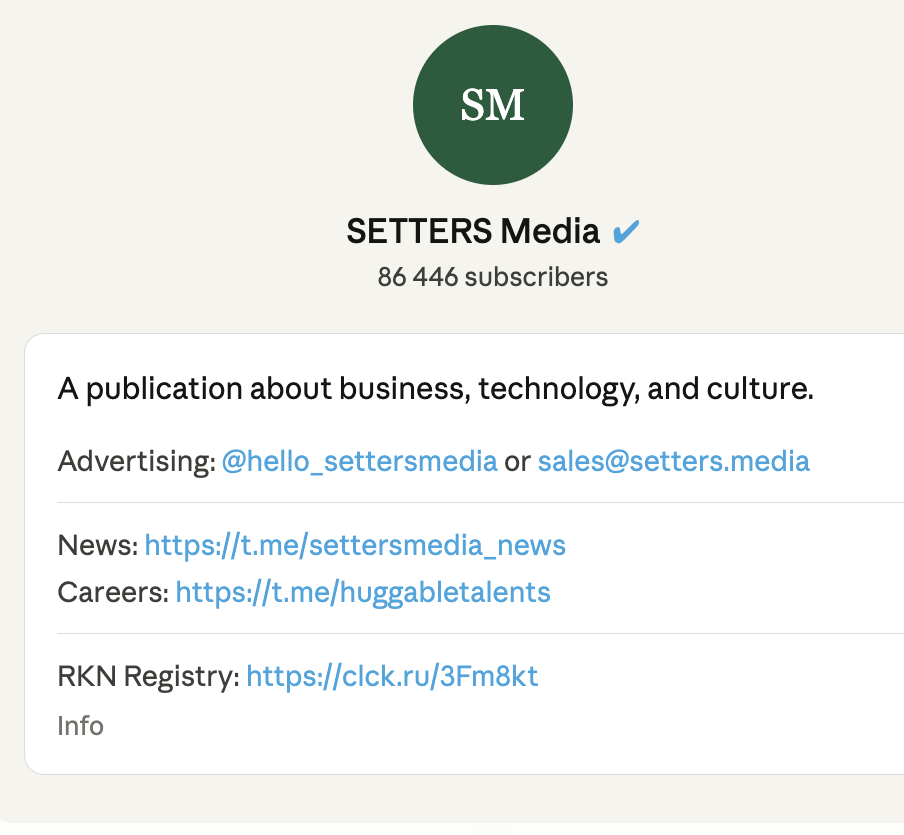
For example, media brand SETTERS Media demonstrates how Telegram can evolve beyond a single channel into a broader content ecosystem.
At first glance, the main channel looks like a typical media publication covering business, technology, and culture. However, a closer look reveals a more sophisticated structure. Alongside the flagship channel, the team operates additional ones focused on specific audience needs – say, a dedicated news channel or a separate career-focused community.
Together, it creates what publishers increasingly call a “traffic loop.”
This approach allows SETTERS Media to segment audiences without diluting the main brand. Users who are primarily interested in breaking news can subscribe to one channel, while those looking for career opportunities can follow another. At the same time, all of these communities remain connected under the same media umbrella.
The most important part is not the niche itself but the ecosystem logic behind it.
Someone might discover a certain channel through a story about technology or business, then end up subscribing to its news channel for daily updates. Later, the same person may join the career-focused community when they’re looking for a new role or simply want to stay closer to the industry.
That’s the advantage of a channel network: people don’t have to leave the ecosystem when their interests evolve. Instead, they can naturally move between related communities depending on what they’re looking for at a given moment.
From the publisher’s perspective, this creates a much stronger relationship with the audience. Rather than building one large channel that tries to serve everyone, they build several connected communities that support each other and keep users engaged for longer.
How a Telegram Media Ecosystem Generates Revenue
Main Media Channel
Business, technology, culture
News Channel
Daily updates
Career Community
Jobs & opportunities
AI Community
Specialized content
Industry Hub
Niche discussions
Monetization Opportunities
Sponsored Posts
Job Placements
Affiliate Offers
Paid Communities
Users enter through different content formats, move between communities based on their interests, and eventually engage with monetized products, services, or partnerships across the ecosystem.
Over time, this dramatically reduces audience acquisition costs because publishers stop depending entirely on paid traffic.
How to Build a Telegram Channel Network
So, if building a network is better than relying on a single channel, where do you actually start?
Here are several basic steps:
- Pick your flagship topic. Most successful Telegram ecosystems begin with one strong channel. Additional communities usually appear later, once publishers understand which topics generate the most engagement.
For example, a technology-focused channel may attract audiences interested in AI, startups, and industry news. Instead of covering everything in one feed, publishers often split these topics into dedicated communities. This gives users more relevant content while creating additional growth and monetization opportunities.
- Do research on the related topics. If you’re unsure where to start, audience behavior can provide some useful clues. According to Statista, news remains the most popular Telegram content category, followed by entertainment and educational channels. Industry-specific communities and creator-led channels also attract a significant share of users. At the same time, brand-owned channels and discount-focused communities tend to have a much smaller audience reach.
Note: The strongest Telegram networks are typically built around related interests rather than random niches. AI naturally overlaps with technology and startups. Finance audiences often follow blockchain news. Entertainment communities can expand into memes, gaming content, Video-on-Demand recommendations, or giveaway-focused channels.
- Build new channels without starting from scratch. Here’s the interesting part: new channels don’t have to start from zero. Once you already have an audience, launching another community becomes significantly easier. Publishers can introduce new channels through reposts, recommendations, pinned messages, and cross-promotion across their existing ecosystem. In many cases, the first few thousand subscribers come from communities they already own.
And if you’re STILL unsure where to start…
this one’s for you:
Telegram Network Checklist
A practical framework for publishers looking to expand from a single Telegram channel into a broader content ecosystem.
Start with one strong channel
Identify the topics that consistently generate engagement
Launch separate channels for audience segments that emerge naturally
Keep the niches closely related
Use your existing channels to seed growth
Make it easy for users to discover other communities within your ecosystem
Why Telegram Channel Networks Publishers Work For Long-Term Monetization
One of the biggest shifts happening in 2026 is that publishers increasingly treat Telegram not as the final monetization destination, but as the starting point of a much larger traffic ecosystem.
A few years ago, many Telegram channels relied almost entirely on direct sponsored posts. Today, publishers use Telegram as the top layer of a broader monetization funnel, redirecting users toward monetized websites (i.e., entertainment portals, AI tool directories, Video-on-Demand platforms, affiliate landing pages, blogs, and niche media hubs).
Once publishers run multiple channels, they control their own traffic. They can shift audiences toward whatever monetization works best, whether that’s ads, subscriptions, affiliate deals, or sponsorships. The top-performing Telegram niches tend to have one thing in common:
Users continuously come back for updates.
That’s why recurring-consumption content dominates the platform. For example:
- Finance communities remain some of Telegram’s strongest niches because audiences constantly monitor news, market reactions, and industry updates in real time;
- Entertainment content performs especially well too;
- Content such as celebrity news, AI series (such as Lana in Dubai);
- Video-on-Demand recommendation hubs continue scaling because they encourage impulsive subscriptions and extremely high engagement.
At the same time, publishers are actively searching for traffic sources less vulnerable to algorithmic volatility. According to Jaimes (2025), messaging platforms continue gaining importance in global traffic distribution patterns, particularly in mobile-first regions. Telegram fits that need extremely well because it allows publishers to maintain relatively direct communication with their audiences while simultaneously driving monetizable external traffic.
How to Avoid The Biggest Mistake With Telegram Channel Networks?
At the beginning, most publishers think that the most optimal strategy is to grow their channels one by one. The problem is that every new channel ends up starting from scratch, which makes scaling much harder than it needs to be…
Instead of launching channels that operate independently, successful publishers build connected ecosystems where audiences can naturally move between communities. Over time, every new channel strengthens the network, making growth easier, cheaper, and less dependent on constantly finding new users. The shift may seem small, but it completely changes the way publishers grow.
Here is a quick cheat-sheet of what fast-growing publishers actually do:
Scaling Priorities
01
Audience Circulation
Encourage users to move between related channels instead of relying on constant audience acquisition.
02
Ecosystem Retention
Keep users engaged within the broader network even as their interests evolve.
03
Internal Traffic Flow
Use cross-promotion and recommendations to redistribute traffic across the network.
04
Multi-Channel Expansion
Build a connected network of complementary channels instead of growing a single destination.
Final Thoughts
The bigger picture becomes clear when you stop looking at channels one by one. The fastest-growing publishers aren’t building a channel; they’re building an ecosystem. Multiple communities, content formats, and monetization streams, all connected. Users keep moving between them instead of drifting away.
This matters because organic reach on most social platforms has become unpredictable. Telegram still offers something rare: direct access to your audience. No algorithm decides who sees your post. In 2026, that’s a real advantage, and it’s why Telegram has grown into much more than a messaging app.
For many publishers, it’s rapidly turning into a full-scale media environment where audience retention, internal traffic flow, and long-term monetization can all exist inside one interconnected ecosystem.