Why Hard Paywalls Don’t Save Publishers, And Freemium Doesn’t Either

Yes, locking content kills traffic, but giving it away for free kills revenue. To maximize your traffic potential, going to extremes is not the solution. This article covers all about monetizing content that’s actually worth paying for.
Paywall, freemium, or free content? The simple answer: Neither. And the real problem is viewing it as single-path monetization, when all it takes is a more advanced approach.
Publishers struggle to balance reach and revenue. Hard paywalls reduce traffic, and fully free content attracts readers but generates little income. Successful publishers increasingly use hybrid monetization strategies that combine subscriptions, advertising, and other revenue streams.
It’s all a matter of changing the question.
So, sit back and read on as we tell you all about paywall, freemium, and a more insightful, relevant, and straightforward, more-encompassing monetization approach.
Contents
hide
Hard Paywalls: What They Are & Why They Work, or Not
Paywalls are layers that allow you to charge before you offer certain or all of your content, services, or software to your traffic, while protecting the content from AI search summaries (as it can’t be discovered). They can be subscription, session, or piece based; appearing harder or softer for your audience.
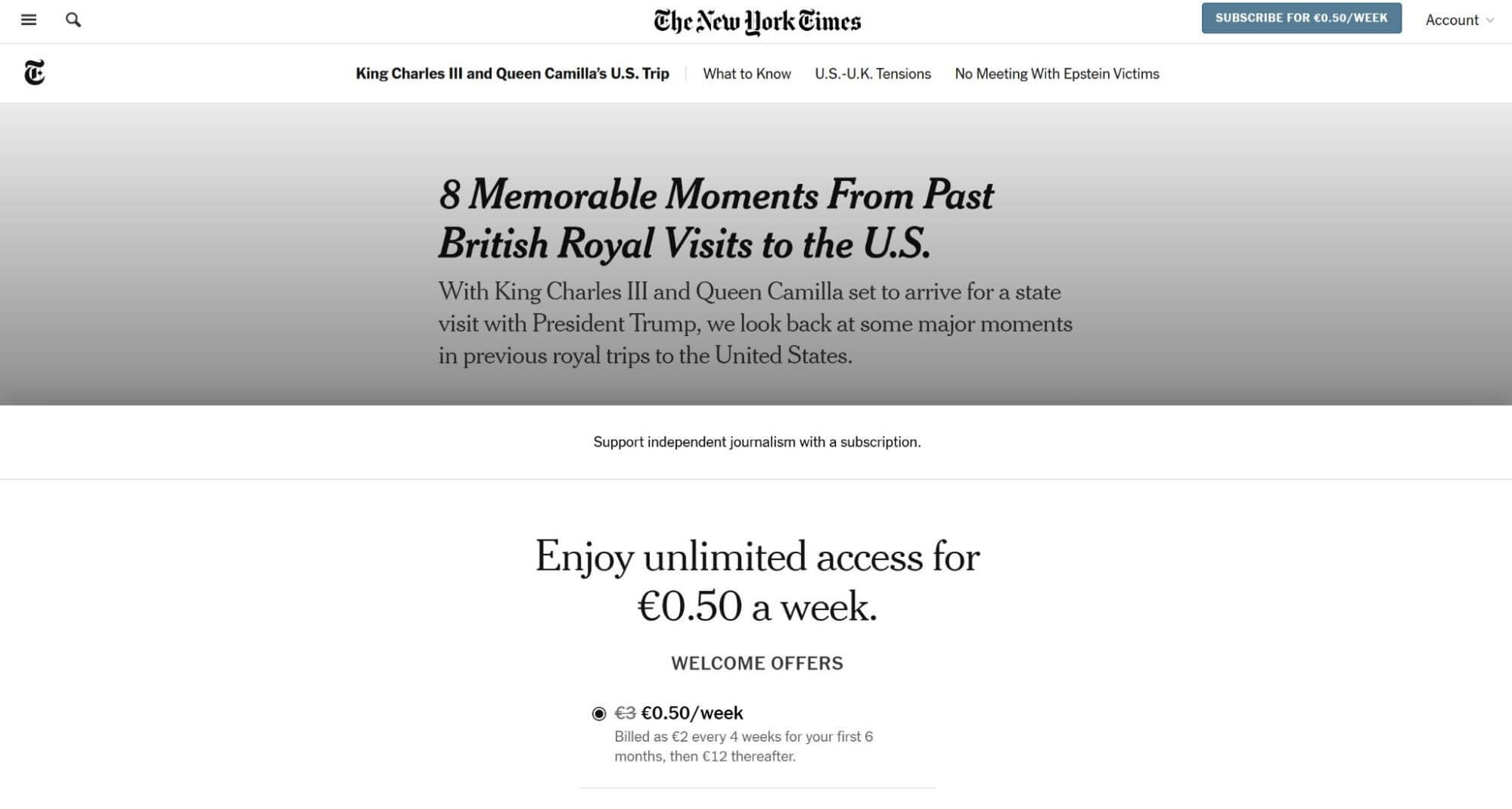
Paywall Example; Image Source: The New York Times
However, Paywalls they can destroy your organic discovery, require strong brand pull, and can kill your social virality. An all-or-nothing type of solution, as it pays the most per reader and reaches the fewest.
The top 3 paywalled publishers in the world have recorded significant increases of 13% or more in subscriptions at the end of 2025: The New York Times Company, Substack, and The Wall Street Journal.
But part of their success is due to what they lock behind their hard paywall – valuable content.

Why Do Hard Paywalls Work for Some
Hard paywalls work best for established brands with must-read, specialty content, or B2B press. They need strong brand authority to withstand traffic losses, and the content must be irreplaceable enough to justify the price.
Beyond brand recognition, the traffic source also matters. Hard paywalls work when the traffic is mostly high-intent: branded search, direct visits, professional referral channels from readers who already know the publication, and return for something specific.
Most importantly, hard paywalls need to gate a special type of content, known as valuable content. And this is just another reason why mostly reputable and established brands manage to successfully lock their content behind Hard Paywalls.
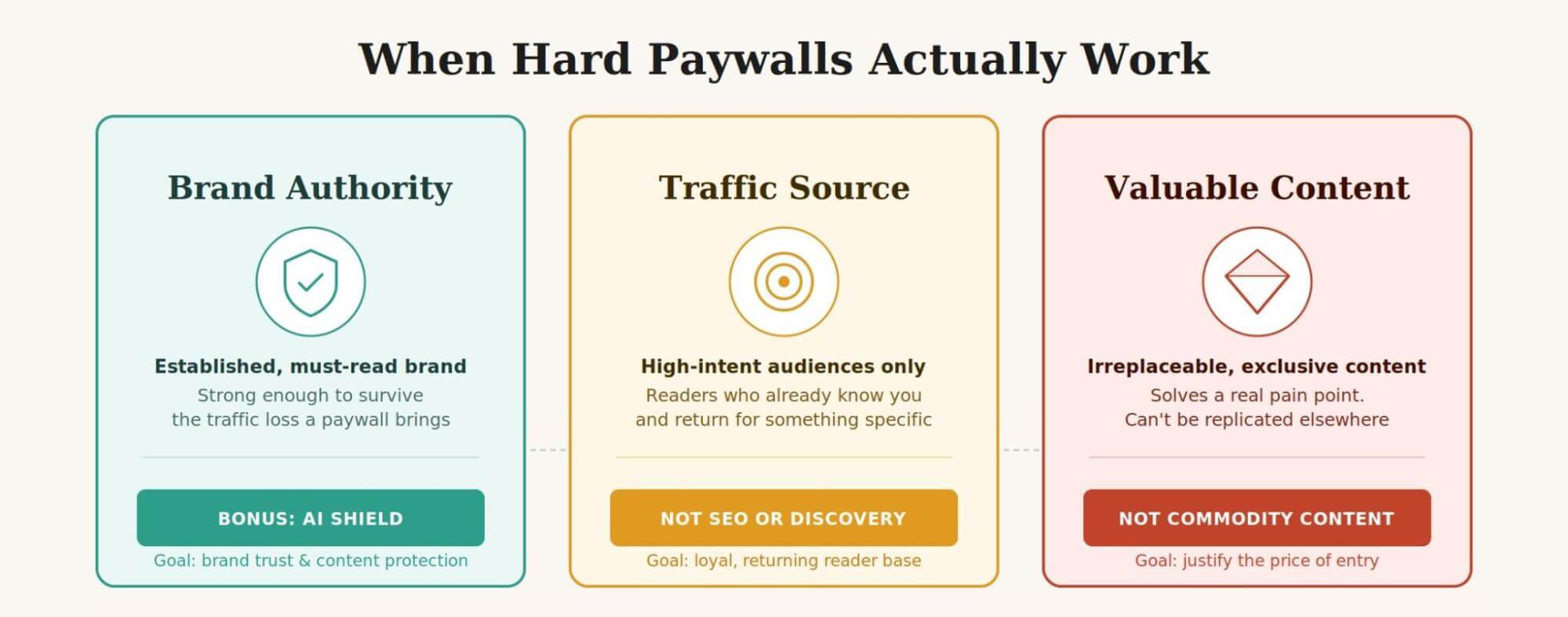
When Hard Paywalls Work
What Really is Valuable Content?
Valuable Content is content that solves a pain point. Exclusive, unique, decision-making, authoritative, insightful, and which can’t be easily replicated – these are the attributes of valuable content. Which is why gating all your content behind a paywall is a bad idea.

So, what types of content can you paywall? Here’s the most popular few:
- Investigative reporting with exclusive sources or original documents and insight
- How-to guides, definitions, tutorials, and other evergreen types of content
- Unique datasets, original research, insightful formats (PDFs, webinars, interviews)
- Business and economic analysis for decision-making professionals
- Tools, keys, calculators, add-ons, game mods, or similar other patches and software aimed at simplifying hard processes

If you need to run a content check, this short infographic explains how:
Valuable Content Screening
Sort every asset into buckets and tune your funnel.
Free
Top of funnel
Broad posts, intros, social clips.
Built for reach & discovery.
Gated
Mid funnel
Webinars, templates, summaries.
Built for lead capture.
Paid
Bottom of funnel
Premium content, training, support.
Built for revenue.
Why Do Hard Paywalls Fail For Many More
Only about 18% of news audiences pay for paywalled content, of the over 69% of major newspapers in the US and Europe that use paywalls.

And there are many documented cases over the years:
- A national magazine lost 80% of its website traffic by installing the paywall overnight, with no notice.
- A study on 42 US newspapers discovered that 85% of these publishers registered a 30% daily average loss in pageviews.
- While a Scandinavian local newspaper confirmed that hard paywalls specifically generate a worse immediate traffic decline than softer versions.
Based on these studies, the traffic did not recover to close the gap, even over time. So, once the paywall is used, the traffic is lost.
As we’ve seen, a hard paywall is only strong when the website using it can establish trust and provide must-read content. Otherwise, here’s where it breaks down:
- Highly competitive niches lose traffic if readers can get the same content elsewhere. Once traffic leaves, you lose them for good.
- SEO-driven (Search Engine Optimization driven) publishers see a loss in daily traffic and overall page views – paywalls drive a 30% drop in daily traffic and 10-55% overall loss in page views
- Sites relying on discovery traffic lose from the potential of their distribution channels – hard paywalls limit the potential to go viral on social media
- SEO visibility and algorithmic discovery drop substantially if you use a hard paywall without a dominant brand authority. Your organic growth can slow down
- Fewer inbound links since your traffic won’t be able to share the pieces they found useful, as they’re gated behind the paywall
- SEO, AEO (Answer Engine Optimization) costs of gating content if you break the rules: failure to comply with search engine guidelines (differentiate paywalled content from cloaking), can lead to reduced crawlable content, weaker internal linking signals, no E-E-A-T signals, and near-zero visibility in AI answer engines
Answer Engine Optimization refers to writing, structuring, and formatting texts and paragraphs clearly, insightfully, and signaling authority so that AI answer engines select and cite it as the direct answer to the user’s search, during a zero-click interaction.
- Subscription fatigue is increasing among users who often encounter paywalls – 41% believe the content isn’t worth the price
- AEO & GEO layers also take a hit even when you follow the guidelines, as AI answer engines can’t read what they can’t see – hard-gated content is invisible to them
- Young audiences expect value before payment across all content types, while hard paywalls ask for commitment before proof of value

Overall, the brutal reality these statistics point to is that ad revenue can rarely be replaced by subscription revenue at the same scale, especially after traffic declines once the paywall goes live.
And the numbers speak for themselves:
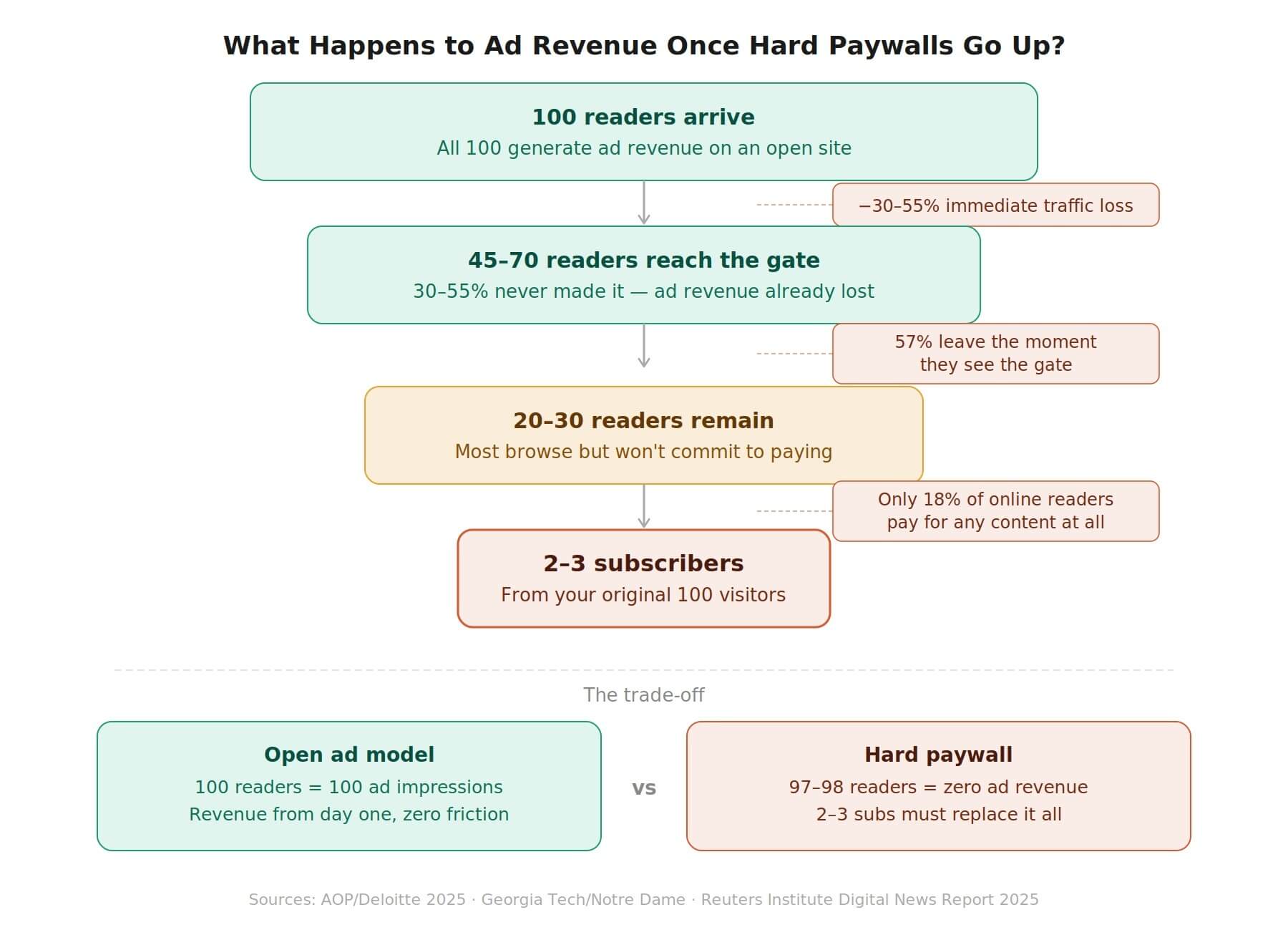
What happens to Ad Revenue once Hard Paywalls go up
Why Freemium Isn’t The Solution Either
Freemium Paywall works by offering enough of your content, services, or software for free to build trust, while also charging for the more premium pieces. While it might sound like a compromise, it immediately introduces editorial and operational struggles.
In fact, research comparing hard paywalls to freemium often shows the former outperforms the latter in direct subscription revenue, as freemium struggles with low conversion rates.
What other struggles could the freemium paywall model bring your way?
From stagnating conversion rates to new editorial struggles, freemium shows weakness in sustaining a meaningful revenue and is too restrictive to grow a loyal audience. But is that all to it? Not quite:
- Low Conversion Rates – only 0.5-2% of users convert under a freemium paywall, so even if it technically works, it still may not scale
- Value confusion from the free-premium tier setup can be an editorial trap – between having a too inclusive free tier, one that’s too strict, or a too expensive entry paid tier, the struggle is real
- Conversion frictions – free content may attract traffic, but not paying users, as converting content from free to paid might damage user trust
- Premium content gets 0 SEO – every piece of content you lock behind premium is invisible to search engines, can’t be shared, won’t be cited by AI answer engines. So your best work will not contribute to your overall rankings
- Your best content only becomes a retention tool, and not one you could better use for discovery – it can’t be featured in search engines, so it can’t help grow your audience
- AI is breaking the free content funnel that freemium depends on – AI overview answers lead to massive traffic drops for how-tos, guides, explainers, and similar content
The reality is that free content without a monetization layer built for your traffic volume is not a strategy. It’s a holding pattern.

When It Might Be A Good Idea To Gate
When you know what valuable content is, understand the ups and downs of putting content behind a paywall, and can support the traffic plunge.
In other words, if your content is unique and hard to replicate, if it’s high intent and the audience is willing to pay, when it has commercial value and actionable insight, and when you absolutely have brand loyalty and a returning audience.
Why Keeping Content Open Might Be Playing It Smart
When you have reach-dependent content, the best option is to keep it free. Especially with traffic that comes mostly from social discovery, or when you’re still building an audience, as paywalls slow acquisition faster than they support monetization.
Valuable content helps your website by attracting search traffic, building topical authority, and feeding answer engines and AI search. That translates into higher traffic volumes and better overall rating and site authority. Gating might play against you.
The same as when you position yourself as an SEO content strategy publisher. Consider that starting from SAAS, to blogging, and newsites, a lot of people are complaining of paywalls being a big bust, chasing users away, and having to start from the beginning.

Here’s what a few publishers had to say about their experience with Paywalls:
- Steer clear of paywalls when just getting started, building your traffic pool

No Paywall at The Start; Image Source: Reddit
- From 47 users to 0 Conversions after the paywall
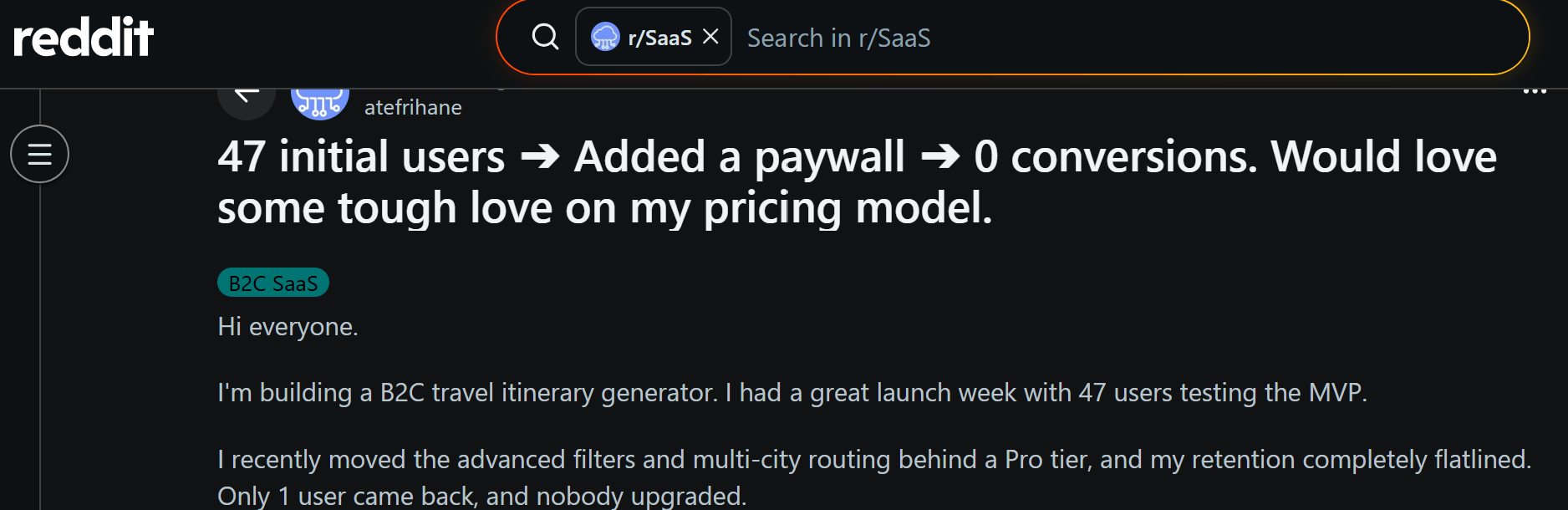
After Paywall, Conversions Tanked; Image Source: Reddit
- Paywall leads to mass uninstall, and reviews of scam pouring in

Paywall leading to Uninstalls and Reviews calling it Scam; Image Source: Reddit
How Smart Publishers Actually Monetize Valuable Content
You’re here because you understand that relying on a single model is not a sustainable strategy, and it costs you money. So, let’s talk about revenue stacks.
Some of your options include:
1. Ad Monetization
Ads allow you to monetize traffic that doesn’t convert to subscriptions. And with diversified formats and multi-layered solutions, platforms like Monetag make it seamless to monetize global traffic that subscription models can’t reach.
2. Affiliate & Offer Monetization
Look into affiliate links, sponsored placements, and product partnerships. Your high-intent content has the potential to bring you the best results with these monetization methods.
3. Premium Content Monetization
You can offer paid newsletters, build premium communities, and share proprietary research in your gated content.
You can also find new ways to monetize your website traffic by running traffic arbitrage experiments and by monetizing traffic beyond subscriptions.
Just keep in mind that no single strategy can sustainably drive growth for small publishers. That’s why the right choice might be to mix them. While finding the right combination is extremely subjective, as it depends on your traffic volume, geo, and content type.
The Solution: Hybrid Monetization
Figuring out how to monetize right now is what you need to focus on. First, see what your traffic type is, based on what they respond to best:
- Casual visitors that arrive through search or social need to first build a relationship with your site – they need free access and respond better to ad-based monetization that demands nothing in return
- Returning readers that haven’t subscribed yet – they’re starting to respond better to more ad formats (push opt-ins, or maybe even affiliate content)
- High-intent users – they provide organic search, looking for you by name, they’re direct visits, and commit to multiple pieces per session – good subscription potential
- Loyal Paying Audiences – the holy grail for premium content, exclusive newsletters, and community access

When all of these traffic categories are present, you can consider a hybrid monetization approach. But, consider that applying a hard paywall, although it might perfectly fit your fourth group, might cost you the first 3 categories.
You have to work in steps, from here on, to reach the ideal hybrid monetization:
1. Leave discovery open and supported by ads → 2. Add a registration wall to move returning readers into direct and ready to address audiences → 3. Only hard gate the content that your most loyal readers will pay for
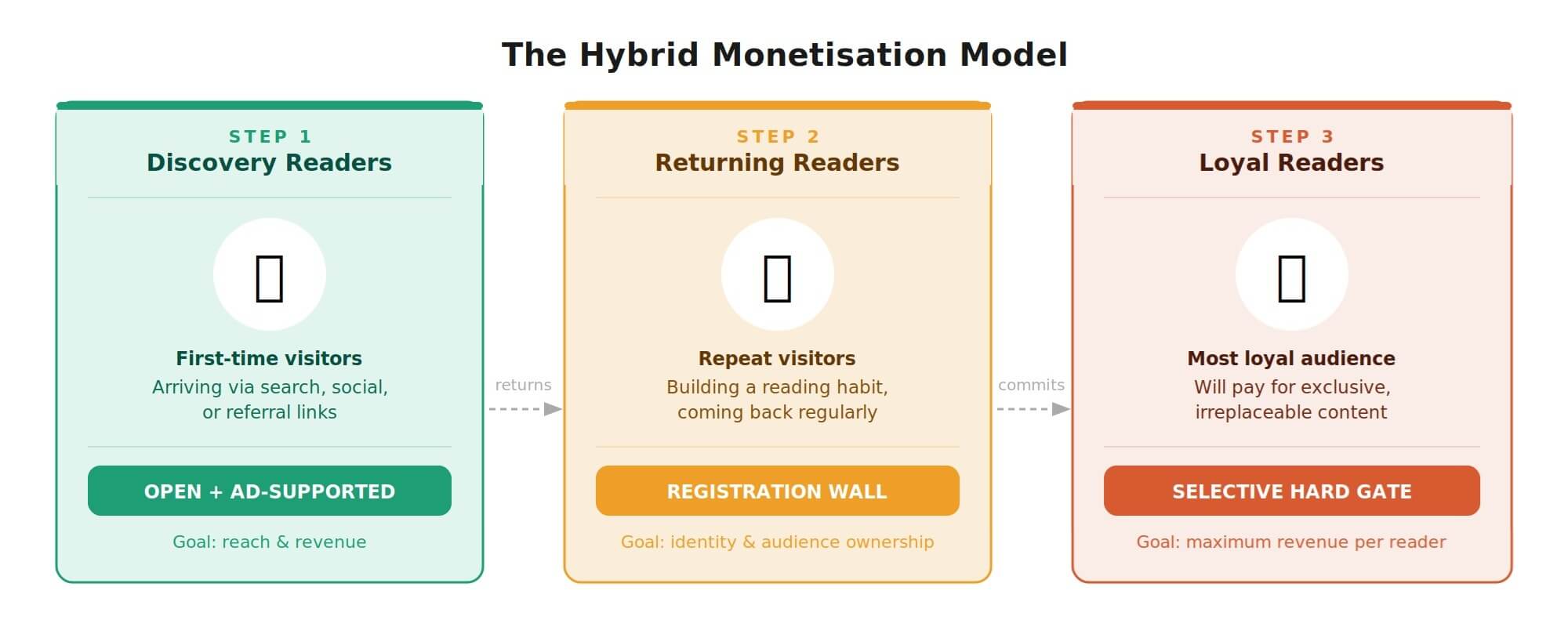
Hybrid Monetization: Add Revenue & Paywall Model
Hybrid monetization gains more and more traction because publishers like you need to find sustainable revenue beyond subscriptions. That is why monetization networks such as Monetag help monetize non-subscribing audiences, without sacrificing traffic growth.
The Problem Was Never Paywall vs. Free
And if you think it is, you might be missing the point entirely. Since no model alone can fix the publisher monetization challenge, you must look into hybrid models to get the most out of your traffic.
This way, you cover all segments:
- Leave discovery open
- Monetize through ads
- Gate truly unique pieces
- Diversify your revenue stream
That’s why smart publishers understand the importance of monetization platforms such as Monetag to help unlock revenue from audiences otherwise lost by using subscription models alone.
What You Can Do Next?
Check if any of your content is genuinely unique. If none, then continue with the free path and build the stack.
Otherwise, check if your traffic is high-intent, if you have an established audience, and if you can withstand a traffic dip. If all these three point to a whooping “Yes”, test a soft gate. But if any one of these is a no, keep it open.
Your best solution is always to match the model to what you can actually work with.

TL;DR Hard Paywalls FAQ
What is a Hard Paywall?
A Hard Paywall is a layer that blocks access to all the content, services, or software on a site, unless the user subscribes (or pays). Hard Paywalls also prevent search engines from crawling and evaluating your content quality, reducing your ranking over time if you don’t have a clearly implemented structure in place.
Does Freemium work for publishers?
Freemium is a soft paywall that keeps part of the content free and part gated. However, it introduces a new editorial complexity, and often can confuse and infuriate users due to the newly implemented gate. To make it work, you need a clear content strategy to start from.
Are Paywalls bad for SEO?
Paywalls reduce crawlable content, weaken topical authority signals, limit inbound links, and reduce visibility in AI answer engines. So they’re not only bad for SEO, but AEO and GEO (Generative Engine Optimization) as well.
What content can be locked behind a paywall?
Your best choice is to only gate valuable content. Only pieces, products, software or anything which is truly unique, can’t be easily replicated, and includes exclusive and proprietary data. But keep in mind that this content will be excluded from SEO, AEO, and GEO results.
How do Publishers monetize content without a Paywall?
The simplest method, especially for beginner publishers, is to work with a monetization platform (like Monetag). But if you’re looking for a more effective approach to maximize your monetization potential, you can run a monetization stack or hybrid monetization strategy to cover all casual visitors, returning users, high-intent users, and paying subscribers.
As no single channel can cover all perfectly, the hybrid approach might be your best solution.
And if you need more help, Monetag’s here for you. But if you’re ready to start monetizing, your dashboard’s just a click away: