What Are Push Notification Ads?

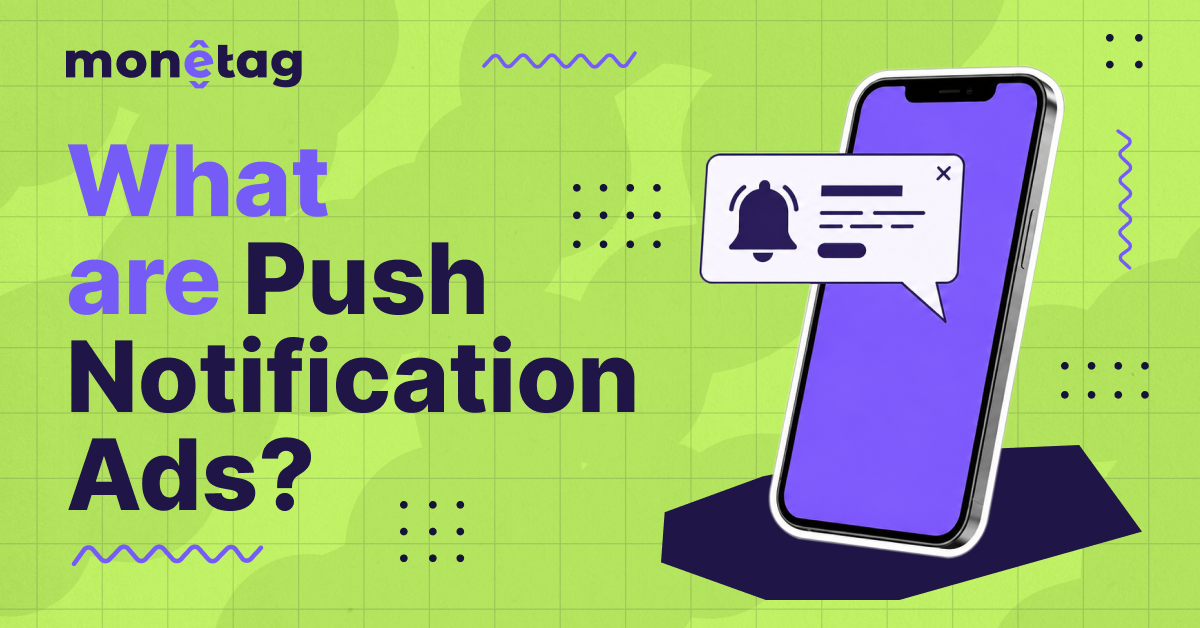
Monetag Push notification ads are short opt-in messages delivered to a subscriber’s browser or device, outside the website that collected the subscription. The user allows them once, then receives ads even after leaving the site. Publishers are paid per impression or per click.
Monetag’s Push Notifications format is compatible with Google AdSense. Learn more about how to run push ads with AdSense.
Contents
hide
How Push Notification Ads Work
- A visitor sees a subscription prompt and opts in to receive notifications from the site.
- The subscription lives with the browser, not the site, so a publisher’s earnings are no longer tied to the visitor loading another page.
- The browser can now deliver ads directly to the subscriber’s device, independent of whether they’re on the site.
- The subscriber sees the notification outside the website, in their device’s notification area, and the publisher gets paid per impression or per click.
Push Notifications vs In-Page Push
Push notification ads and in-page push may look similar, but they use different delivery methods. Push notification ads require a one-time opt-in. After subscribing, a user can receive notifications through the browser or device even after leaving the website. In-page push does not require an opt-in because it appears directly inside the page and is visible only while the visitor is browsing.
The formats can therefore serve different parts of a publisher’s audience. In-page push reaches current website visitors, while push notifications can reach subscribers after their session has ended. Publishers may use either format as one of several ways to monetize a website. The table below summarises the practical differences between them.
| Format | Requires user opt-in | Where it appears | Works after the user leaves the site | Monetag product page |
|---|---|---|---|---|
| Push Notifications | Yes | Browser/OS notification area, outside the site | Yes | Monetag push notification ads |
| In-Page Push | No | Inside the page, styled like a native banner | No | In-page push |
Push Notifications
Delivered outside the page, even when it’s closed
Notice card floats above the page, in the OS/browser notification area. The underlying tab can even be in the background.
In-Page Push
Loads inside the page, only while it’s open
The ad slot sits in the content flow, styled like a native block. It disappears the moment the visitor closes the tab.
Do Push Notification Ads Work With Google AdSense
Monetag’s Push Notifications format is compatible with Google AdSense. Publishers can review Monetag’s dedicated explanation of how to run push ads with AdSense before implementing the format.
Push Notification Ads vs Popunder
Push notification ads require a user to subscribe and can reach that subscriber after they leave the website. A popunder opens a new browser window or tab behind the active page and becomes visible after the user closes or minimises that page. See what is a popunder ad for a complete definition.
The formats therefore reach users at different moments. Push notifications address an opted-in audience outside the website, while popunders are connected to an active browsing session. For a closer comparison, see push notification ads compared with popunder ads.
What Push Ads Pay Publishers
Push notification ads are paid per impression or per click, depending on the ad network’s setup. There’s no single rate: what a publisher earns depends on the subscriber’s geo, the site’s vertical, how often notifications are sent, and the subscriber’s device. Because these factors vary so much from one publisher to another, CPM for push notifications isn’t something that can be stated as a flat number. For context, here’s the network-wide average over the past 30 days — individual results vary widely, as the table below shows
Push Notifications
Average CPM — Last 30 Days
Jul 28 – Aug 26, 2026.
$0.53
Network-wide average CPM
Top GEOs by Volume (sorted by CPM)
Highest-traffic markets, ordered highest to lowest CPM
| GEO | Impressions | CPM |
|---|---|---|
| 01Thailand | 394M | $1.76 |
| 02Indonesia | 802M | $1.24 |
| 03Nigeria | 416M | $0.92 |
| 04United States | 567M | $0.64 |
| 05Philippines | 434M | $0.64 |
| 06United Kingdom | 798M | $0.60 |
| 07Mexico | 460M | $0.60 |
| 08Germany | 2.03B | $0.20 |
| 09Pakistan | 847M | $0.12 |
Top GEOs by CPM
Highest-paying markets (min. 10M impressions)
| GEO | Impressions | CPM |
|---|---|---|
| 01Taiwan | 25M | $2.32 |
| 02Bulgaria | 24M | $1.80 |
| 03Thailand | 394M | $1.76 |
| 04Tajikistan | 14M | $1.68 |
| 05South Korea | 15M | $1.56 |
| 06Australia | 67M | $1.48 |
| 07Brazil | 253M | $1.40 |
| 08Mauritania | 12M | $1.40 |
| 08Canada | 115M | $1.36 |
| 09Morocco | 42M | $1.32 |
Not typical figures — the network-wide average CPM was $0.53 over the same period.
The Downsides of Push Notification Ads
- Getting a subscriber requires explicit permission, and some visitors decline the opt-in prompt.
- Showing notifications too often pushes subscribers to unsubscribe, so it’s important to be careful with frequency.
- Support depends on the visitor’s browser and OS, so coverage isn’t uniform across every device.

How to Start Running Push Ads on a Website
- Sign up as a publisher and add the site you want to monetize.
- Add the push subscription tag to your site so visitors can opt in.
- Set your preferences and activate the format so eligible subscribers can receive notifications after opting in.
Push Notification Ads FAQ
Are push notification ads the same as in-page push?
No. Push notification ads are delivered through the browser to a subscriber’s device and appear outside the website, even after the user has left. In-page push loads inside the page itself, like a native banner, and only shows while the user is on the site. They require different levels of user permission and reach different audiences.
Are push notification ads safe, or is it spam?
They’re not spam by design – a user only receives them after actively opting in, and can unsubscribe at any time. What can feel spammy is frequency: sending too many notifications is what actually drives complaints and unsubscribes, not the format itself. Responsible frequency capping is what keeps a subscriber base opted in long-term.
Can I run push ads alongside Google AdSense?
Monetag’s Push Notifications format is compatible with Google AdSense. Publishers considering both formats should review the dedicated guide on how to run push ads with AdSense and follow the applicable platform and placement requirements. The linked proof page provides the supporting explanation for this compatibility statement.
Do users have to opt in to push ads?
Yes. A visitor has to actively subscribe – usually by accepting a browser permission prompt – before they receive any push notification ads. Nothing is delivered without that one-time opt-in. Once subscribed, the user keeps receiving notifications until they unsubscribe or block them at the browser level, even if they never return to the site.
How do publishers get paid for push notification ads?
Publishers are paid per impression or per click, depending on the campaign and the ad network’s setup. The actual rate depends on factors such as the subscriber’s GEO, the site’s vertical, notification frequency, and the subscriber’s device. These variables are not fixed, so payout levels vary between publishers and campaigns.
Can a user turn push ads off?
Yes, at any time. Users can unsubscribe directly from the notification, through their browser’s notification settings, or by blocking the site’s permission entirely. Once they do, delivery stops immediately – there’s no way for a publisher to keep sending notifications to someone who has opted out. That’s why high frequency tends to backfire.