SEO in 2026: Between the Rankings by Chance and Surviving AI, Google, and Declining Monetization

You know the old SEO Playbook? Publish helpful content, optimize, build links, and witness traffic roll in. Now, that bridge has burned. Well… almost.
In 2026, SEO is unstable. And not because publishers forgot how to create content, but because users search differently.
Moreover, Helpful Content Updates (HCUs) can wipe out an entire website’s traffic overnight, and AI-generated answers lead to zero clicks.
The result: SEO on its own is risky and costly – in terms of traffic loss, visibility, and engagement.
And since search traffic will always be important, so will keeping up with the new trends.
Join us as we break down eight SEO struggles that publishers are facing this year, how they can affect you, and what you can do to overcome them.
Contents
Struggle 1. The Ranking Algorithms: HCU & Core Updates
In 2026, we can certainly say that search isn’t stable anymore, while a handful of updates can pull the plug on your site’s traffic. And comments like this one below keep on pouring in.

Image Source: Reddit
Google’s Helpful Content Updates (HCU) and overcomplicated ranking algorithms no longer just control ranks but also reclassify sites. So if your website looks thin or is made for SEO, it can be lost in search results. All without so much as a warning.
AI summaries and similar ranking features are completely changing how people respond to and click on search results globally. In fact, new sites registered a significant drop in search referrals of over 30% year-over-year, while specialists expect this drop to increase by about 10% more in the next 3 years.
Are you doing all the right things? You can still register major losses, one way or another, by:
- Triggering the algorithm to label your site as anything but helpful, where recovery can take years
- Taking hits using classic strategies, such as frequent publishing, backlinks, and microsite networks
What’s The Solution?
So, how do you work around this? Here’s what Algole Rashika, a Digital Marketer specialized in SEO, has to say:
Google’s Helpful Content Updates judge the whole site. Small SEO fixes won’t stop volatility, but content that goes deeper into user needs and is locally relevant can definitely help regain stability.
In other words, you have to stop optimizing as you did back in 2023 and start investing in content that will always have value, not just rank now. We don’t mean evergreen content.
Right, you can’t rely on generic evergreen posts or AI filler anymore. The focus has to be on solving actual user problems with content that feels genuinely helpful.
However, that’s just the beginning, as you should also invest in a broader strategy that doesn’t rely exclusively on search rank. As Algole explains, for instance:
“The smartest move is to publish on platforms like LinkedIn Articles or Medium, focusing on trending topics and user pain‑points that people are actively searching for. That way, your content isn’t just visible, it’s credible, relevant, and built to sustain rankings.”
Or take a page out of one of our clients’ book, and expand on the idea that our marketer exemplifies – look for localized news and take advantage of their importance for your traffic.
You can read his full case study here:
Struggle 2. Zero-Click Search: Users Get Answers Straight On The Search Page
AI-overviews and other AI-driven search features make it much simpler for users to get all they need straight away, literally reshaping the user behavior – they no longer feel the need to click to get more from the publisher’s site.

Image Source: Reddit
As more SERP space is being consumed by AI-generated summaries, not only do visits drop, but more searches end up in zero-click.
In fact, recent studies show that zero-click search volumes reach as high as almost 69% of all queries.
What’s The Solution?
Regardless of whether you rank for a keyword, you still might not get traffic, as users go for quick answers and couldn’t care less about visiting your page. But what do experts have to say?
These influences made SEO experts re-strategize their content plan and crowned ‘visibility’ as the SEO metric to track and measure in this AI era. […] And to achieve visibility on SERPs and LLMs, your content should optimize for EEAT and entity-based SEO.
Moreover, invest in GEO (Generative Engine Optimization), AEO (Answer Engine Optimization), AIO (AI Optimization), RAG (Retrieval Augmented Optimization), XOS (Search Experience Optimization), and the whole alphabet of the AI-driven ecosystem. Basically, optimize not just for ranking but also for being quoted, linked, and mentioned in AI queries.
How do you achieve that?
- By answering potential questions that users might ask in clear 2-3 sentences at the top of your content.
- Using structural content definitions, step lists, comparison tables, and clear facts that AI systems can crawl and extract.
- Create more meaningful content with intent, for users who actually click and visit your website.
Adding to the list from above, Wisdom explains:
“SEO content strategists use MOFU (Middle of the Funnel) and BOFU (Bottom of the Funnel) content to attract clicks and answer queries. Adding FAQs to your content also gives you answers to users’ queries. Another solution is optimising for entity-based SEO by creating content clusters to achieve visibility on Google and LLMs.”
Struggle 3. Indexing Isn’t Guaranteed: “Crawled But Not Indexed” Is The New Normal
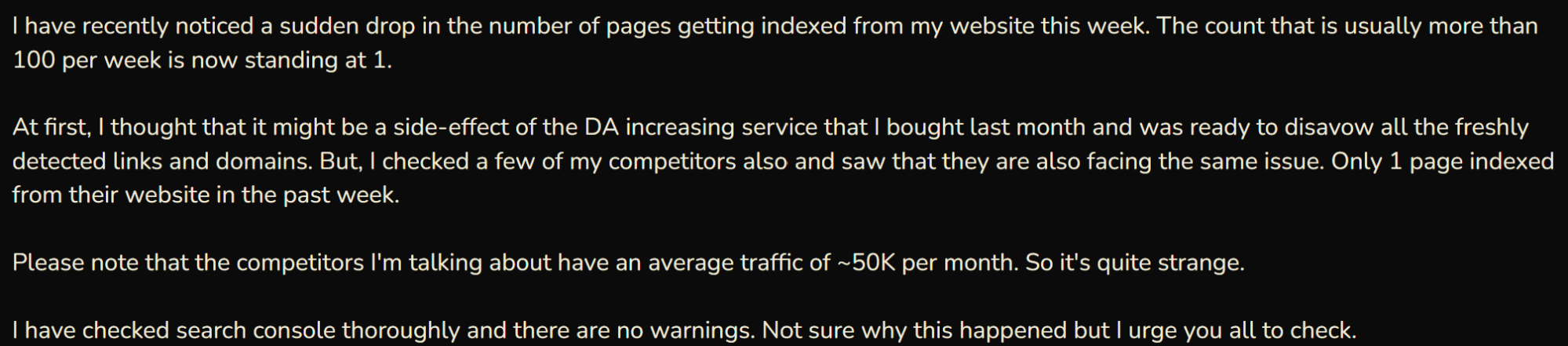
Image Source: BlackHatWorld
Metadata isn’t performing as it did pre-AI, since Google and other search engines are saving server resources. While the huge AI-generated data and low-value content are mostly causing this, many pages are being Crawled – currently not indexed.
This new plague can kill most of your great content, as Google will rank most “not valuable enough” to occupy space in its database. When this happens, your pages never show up in search results at all.
So you either end up with just a few pages, or even the least important pages getting indexed.
What’s The Solution?
According to the same thread reply, the solution might be addressing the underlying cause:
The reason is not bad backlinks, but with a high degree of probability, the content of your pages. If this is template-based, non-original AI content with a low number of entities confirming its topicality, such pages will drop out of the index. Most often, in Google Search Console, they will have the status ‘Crawled, currently not indexed’.
The move could also come from prioritizing fewer, higher-authority pages, using internal linking, social bursts, and structured data to help search engines decide your pages are worthy, and auditing the site for crawl errors and orphaned content monthly.
Just keep in mind that while internal linking helps search engines discover and prioritize pages, structured data helps to better understand content, and distribution (including social sharing) can help get more exposure for new URLs – together they all support the indexing process, but not separately.
Looking for the key to social traffic? Your search is over:

Sure, getting indexed now might require ritual-dance-like efforts (Indexing API, link pushes, social signals), all of which make the process more expensive. But the result is visible – or better yet – visibility.
Struggle 4. The E-E-A-T Squeeze: Real Expertise Costs Money
Experience-Expertise-Authoritativeness-Trustworthiness (E-E-A-T), isn’t a buzzword anymore. It’s a tax. Our expert SEO, Wisdom, shares his experience with it:
EEAT plays a big role when dishing out helpful content. It was EAT before Google added an “E” which stands for experience. Thus, you can tell stories and prove your expertise in your unique way.
What is E-E-A-T? Glad you asked!
E-E-A-t is Google’s way of assessing whether your content is high-quality. It supports your GEO credibility signals, and helps AI agents evaluate if your content is reliable, created from a point of:
- Experience – having already tried and tested the subject for yourself,
- Expertise – having more than experience, gained knowledge on how to solve or address certain issues, supported by accurate and useful info,
- Authority – having the background to show for your experience and expertise in a certain field recognized by others (citations, mentions, reputation, industry presence),
- And finally – Trustworthiness – demonstrating accuracy, transparency, safety, reliability, and clear sourcing.
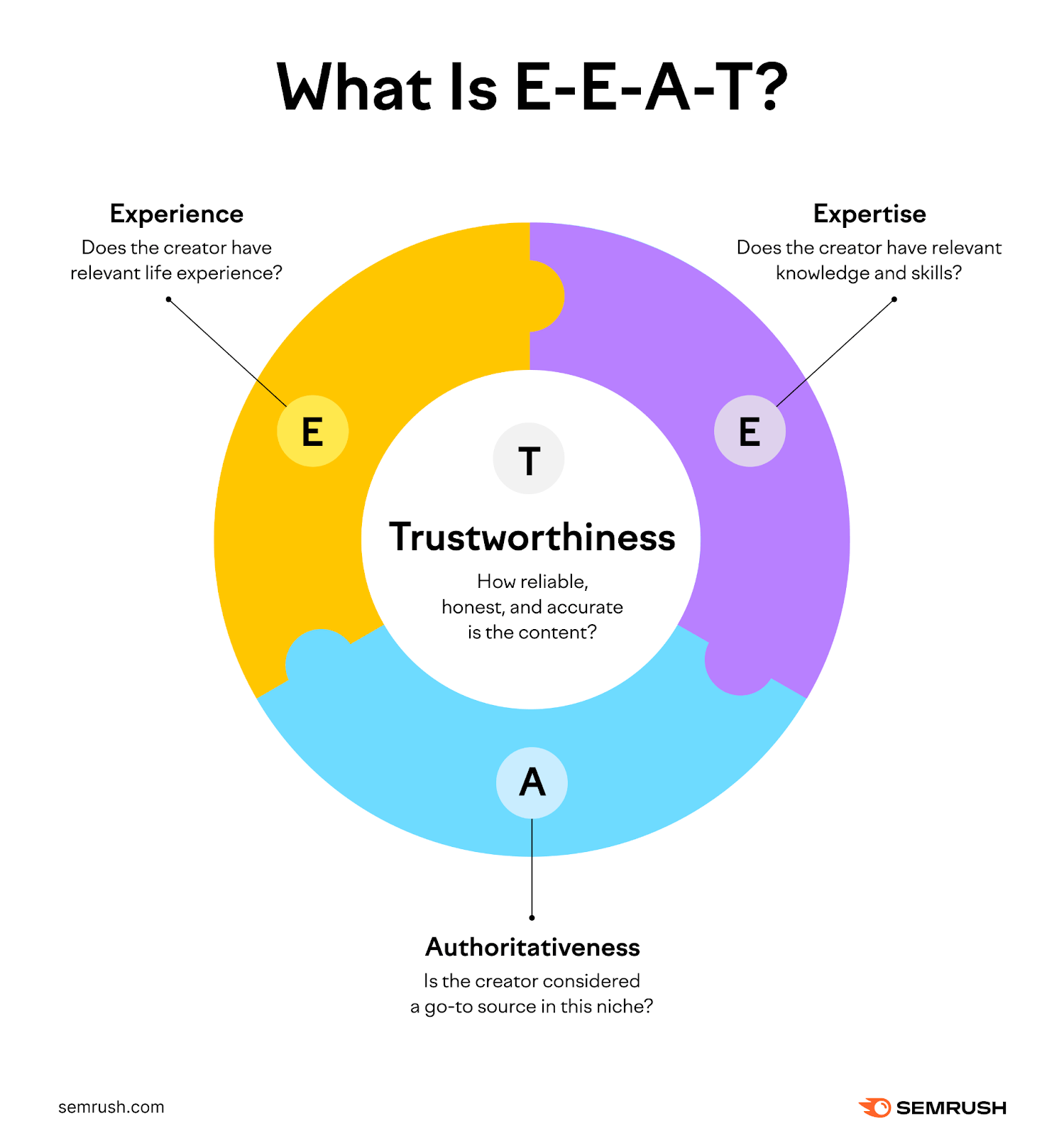
What is E-E-A-T – Image Source: SemRush
Content not following the E-E-A-T formula gets buried. And don’t even think of using fake authors, stock credentials, AI-generated bios, or generic info because ranking systems (through the Knowledge Graph) can track author reputation, publishing history, and digital footprint.
Right, hiring experts is expensive, but the downside is using AI-generated content and paying the price not only in SEO, but as we’ve seen, de-indexing, zero-clicks, and other issues down the road.
You can still observe niche sites trying to beat the game, all looking like indistinct blobs, which get filtered out.
But that’s just the tip of the problem. In this game, there’s no faking till you make it, and real problems arise even when using the E-E-A-T method correctly:
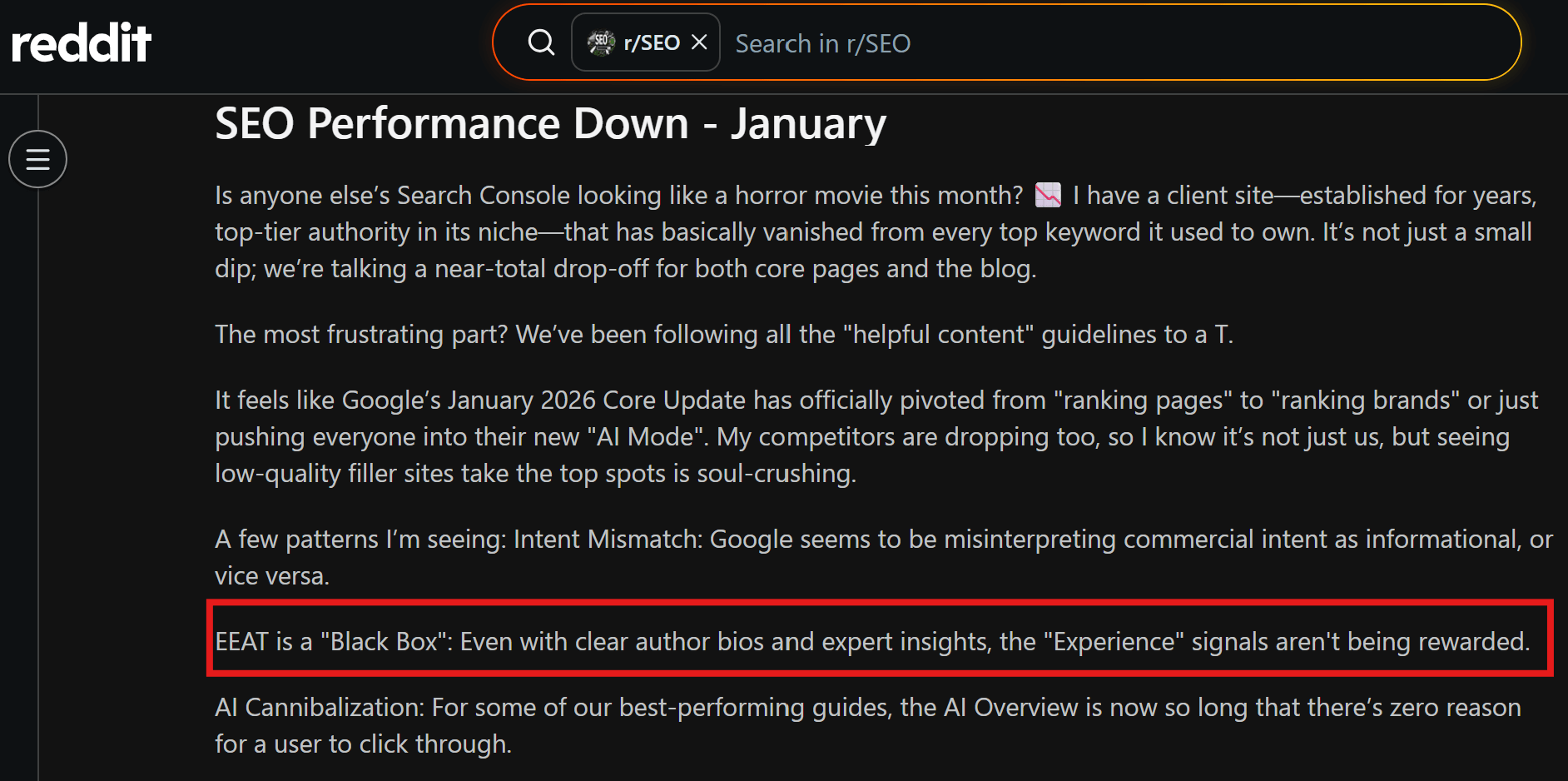
Image Source: Reddit
What’s The Solution?
Following the E-E-A-T strategy, you must provide real expert quotes for each piece of content, original research, and verifiable credentials, while also employing formats which integrate real insight – think original, human-created info and data which stays true to your brand, your site identity.
Content clustering system with E-E-A-T applied to every article in the system helps search crawlers understand that you’re the go-to expert for this subject. Content structure is crucial and a must-have for brand content. […] You need to strategize on how to write well-structured content without losing the brand’s voice or essence.
When you can’t reach experts, reach out to your users or your audience and provide their POV. Here’s how Algole put it better:
Good content may get attention, but without authority signals, it rarely lasts. In today’s AI‑driven landscape, citations, expert proof, and mentions are what make content trustworthy, not just well‑written.
Struggle 5. International and Multilingual Search: The Semantic Collapse
Separate country pages, hreflang, localized content – and any traditional international SEO tactics you might think of – seem to be less effective as AI systems increasingly combine or simplify similar questions across locales.
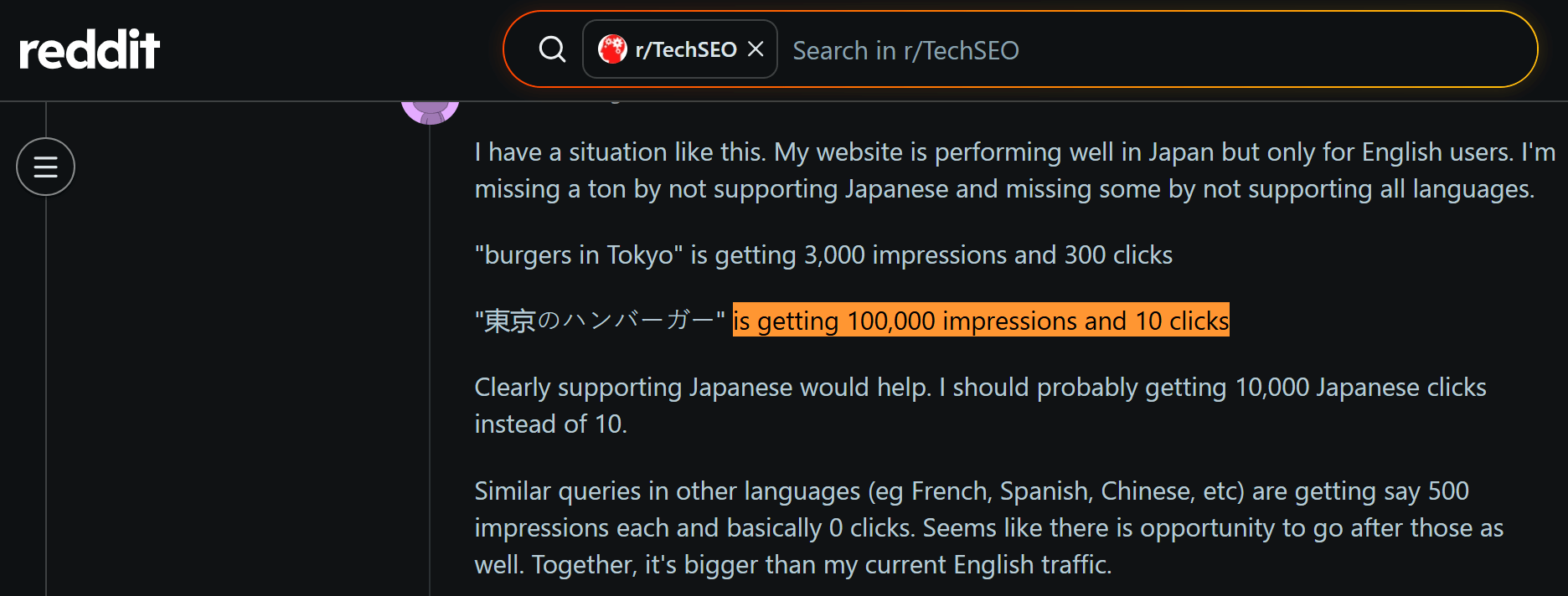
Image Source: Reddit
In the example above, we see a significant mismatch in the language provided and clicks. Yet, this is not the only example, as pages meant for specific markets can be replaced or mixed into a universal AI answer since the model might see them as similar.
What’s The Solution?
It might be as simple as embedding market-specific details, such as currency, local data, references, or examples, so that your page can’t be treated as generic by AI any longer. Or to localize beyond language. In fact, here’s what one user is suggesting:
Add a localized Japanese version of the page, it gets indexed for the Japanese query, you get a snippet in Japanese, and then natives click it more eagerly, you get more clicks and better CTR. Just don’t forget to add correct hreflangs, you could add it to on-page HTML in < head >, to the sitemap, and HTTP header.
Careful, though, if your content doesn’t respect market-specific characteristics, it can be outranked by other local sources or absorbed into generalized AI summaries.
Struggle 6. Google Discover: The Most Addictive And Dangerous Traffic Source
Has Discover shifted from being the solution, into becoming the problem it swore to destroy – traffic loss? The personalised, feed-based engine that publishers used to swear it can boost content, now makes them complain and call it a “volatility tax”:
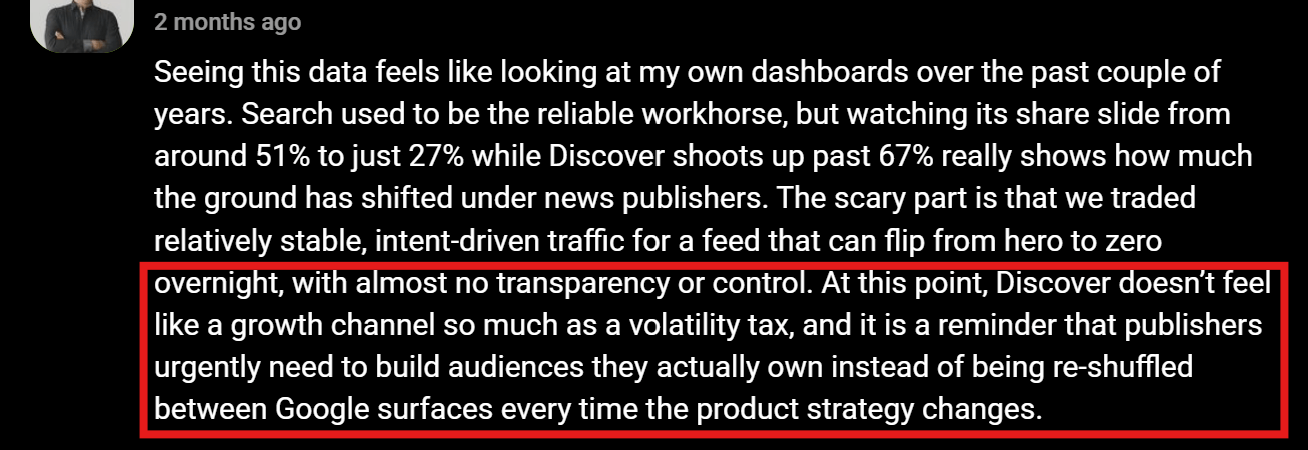
Image Source: SERoundTable
The tool that can give you huge audience spikes with little to no SEO, at the same time, can remove it instantly. Think of traffic jumps from thousands of daily visits to zero – not a hey, how you doing… You know the rest. But literally from (Tiger/Traffic) King, to Janitor.
What’s The Solution?
With the level of volatility making Discover extremely risky, especially since it comes with no clear optimization framework, reliable diagnostics, or stable forecasting model, you need to use it with care.
Moreover, if you view it as your main strategy, keep in mind that it can destabilize your entire business. Instead, consider shifting to a persistent, reliable presence for the algorithm.
For that, here’s what you need to focus on more:
- Use Discover as an accelerator, building alternative streams: email lists, social platforms, referrals, or direct engagement channels
- Continue building your organic search and valuable evergreen content with really useful pieces that give your search visibility outside the feed – comparison pages, resource hubs, guides, etc.
- Invest in AI-readable content (using AI-retrieval sections) to improve citations – entity, semantics, but also schema, structured headings, and clear definitions; as well as optimizing to be included in AI answers
This way, you avoid being at the mercy of a single traffic feed, build stability, and make your site visible, both organically and AI-readable.
Struggle 7. Platform Shifts And Changing Search Behaviour: Tiktok & Youtube
Google no longer dominates search, as younger users (mostly Gen Z and even Alpha) swarm to other, short-form content to look for answers – TikTok, YouTube Shorts, and Instagram Reels.
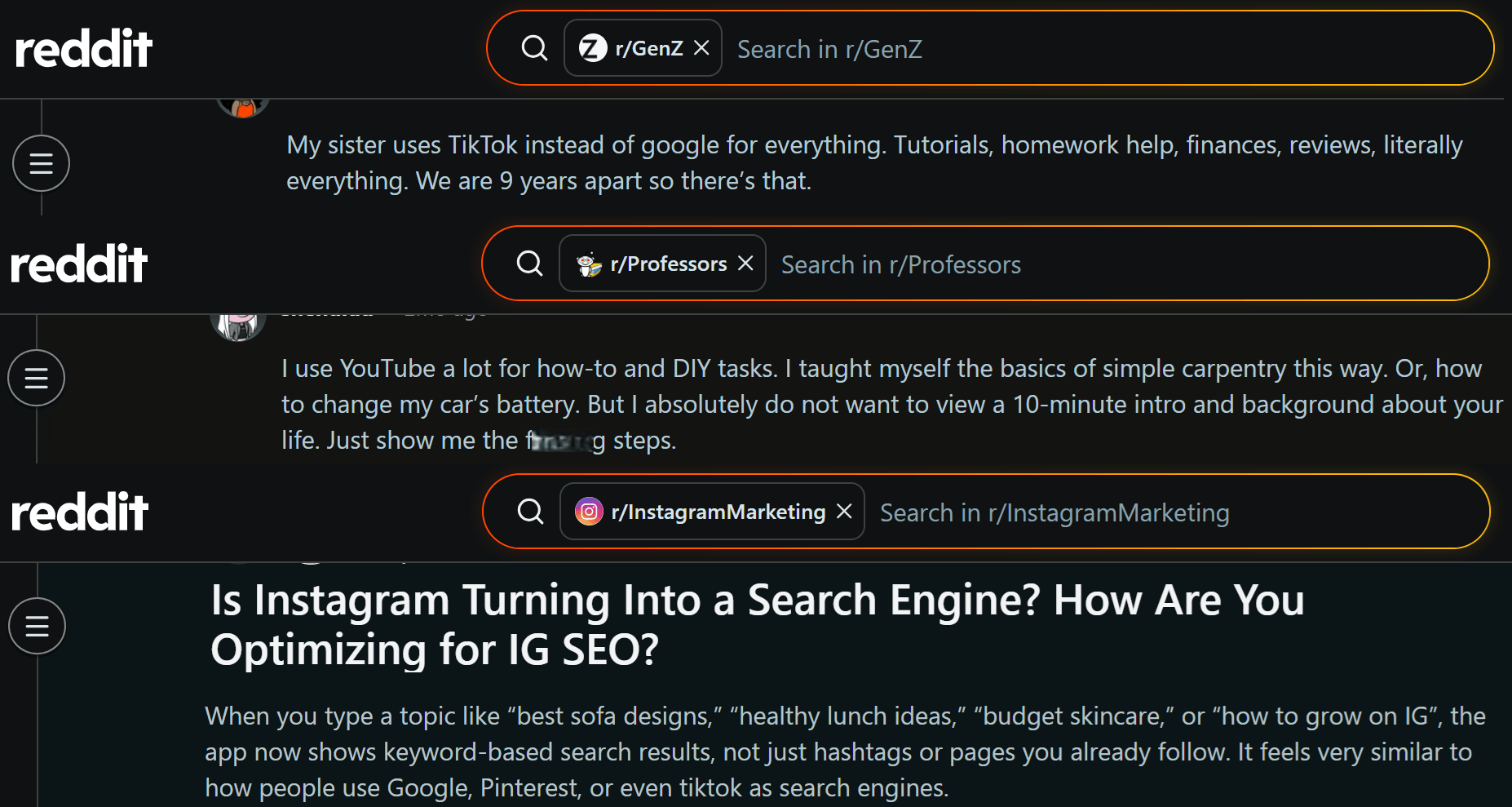
Image Source: Reddit
Younger generations view social platforms as search engines, especially for how-to and advice queries. And let’s be honest, so do many millennials.
So if you still count on good ol’ Google Search for traffic, you’re not in sync and desperately need to catch up.
What’s The Solution?
This time, pretty straightforward: repurpose your content into formats that fit TikTok, YouTube, Instagram, and even Reddit – video summaries, social posts, short how-tos, and even comments.
If you really want to win at this game, treat these social platforms as SEO channels.
2026 SEO Play in Short
In order to keep up with the trends and reduce the risk of bleeding traffic to various SEO challenges, make sure to stop being dependent on single traffic channels. You can also write for retrieval instead of just ranking, diversify your discovery stack, and stay monetization-ready.
Here’s what Yoav Bernstein, Global SEO & GEO/AEO Specialist, suggests:
Currently, you have to be everywhere: LLMs, search engines, social media that is relevant to your business, relevant forums, YouTube, and other video platforms, Reddit, Quora, etc. But you have to build strategically and not just shoot everywhere and hope that something will stick.
Just to be sure, you can follow this short 2026 checklist.
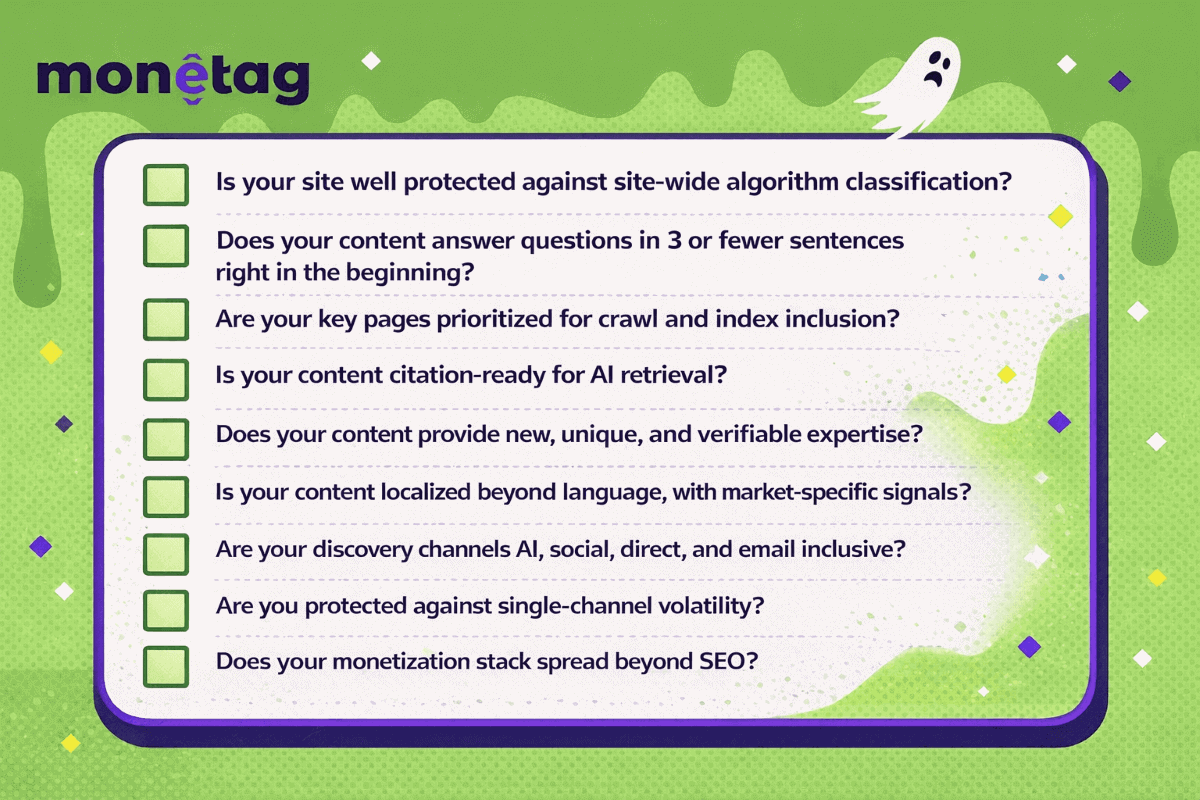
2026 SEO Checklist – Monetag
Fix all these, and you’re set for a quiet, SEO-issue-free 2026. If you need more help, don’t forget to reach out.
In 2026, SEO is less about beating the algorithm and more about surviving the evolution. Adapt, and you will thrive.
FAQs
Q: Is SEO dead in 2026?
A: No – traditional SEO might be less reliable, but search visibility still matters, as long as you optimize for AI and answer engines as well.
Q. Why am I losing traffic even when I rank #1?
A: This is mostly due to AI Overviews and zero-click results, which provide all the answers the user needs without them having to go on your website.
Q. How can smaller publishers compete?
A. Simply follow the E-E-A-T structure, provide AI-retrieval paragraphs, and ensure cross-channel visibility.
Got all you need and want to get your monetization game going strong?