SEO Conspiracy Theories: What Publishers Secretly Want to Believe (But Try Not to)

Nothing works again, and the rankings aren’t moving? You’ve tweaked the titles, rewritten the content, fixed the technical stuff, but your traffic still won’t flow? You’re tired and don’t have the energy to debug SEO tonight?
Take a deep breath. For one evening, you’re officially allowed to stop trying to figure it out. We’ve collected the juiciest SEO conspiracy theories out there. Pick the one you like most and use it as your excuse for today.
Tomorrow, we go back to fighting the algorithm, and tonight, let’s blame the shadows.
Theory 1: Google Has a Whitelist (And You’re Not On It)

This one became popular after the leak of Google API documentation in 2024. Yes, that case when 2,500 pages with detailed descriptions of how search algorithms work became available to curious experts and publishers.

What’s the theory? Google manually whitelists certain domains – mostly those owned by huge brands. Such whitelisted sites get special treatment: they can freely use AI-generated content, overwhelm people with spam, or publish low-quality pages. Meanwhile, small sites are penalized for even a single word generated by AI (sometimes before they even publish it).
What’s behind it? The leaked documents do contain a parameter called isSmallPersonalSite. Furious publishers immediately assumed it was used to demote sites in search results. In reality, there’s no evidence of that. It could just as easily be used to identify, boost, or treat small sites differently, or simply for internal classification with no direct ranking impact at all.
Sceptic’s opinion: Of course, that’s not true. Big brands rank mainly because they’re well-known and already have strong sites. A lot of their product pages rank simply because smaller sites don’t even try to compete. You won’t beat Amazon or Walmart on broad keywords, but outranking them on specific product queries is absolutely possible.
Theory 2: No Google Ads – No Organic Traffic
This theory is almost a classic, but it’s still widely discussed on Reddit and various SEO forums.
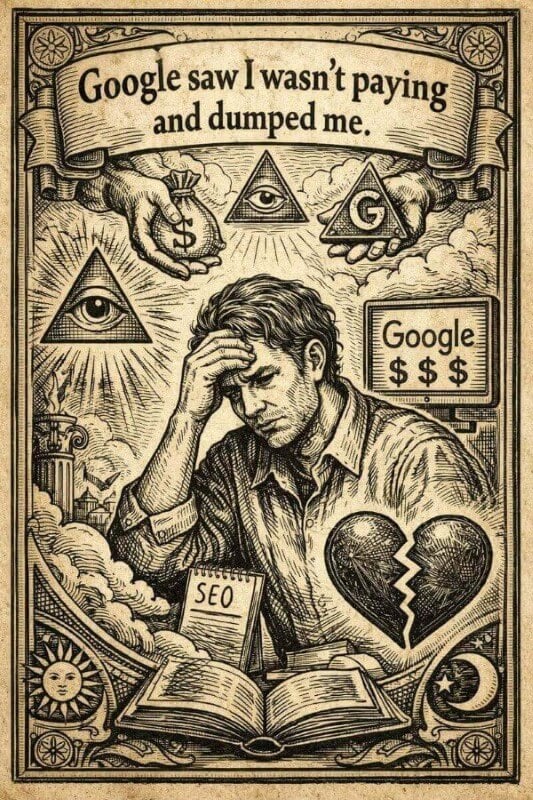
What’s the theory about? The organic search doesn’t work as it’s supposed to – and your SEO efforts don’t matter at all, as all you need to grow is to send as much as possible to Google Ads. The logic is simple: you can purchase ads? Great, you are a paying business! Fine, here’s some organic traffic as a bonus. You don’t bring money to the table? Okay, don’t expect any visibility in organic search.
What’s behind it: Ads don’t buy you organic rankings. However, they might increase your site’s visibility: more people see you, and later search for it directly or recognize it in organic results. Also, when more people search for a brand, click its results, and don’t bounce back, Google may interpret this as higher relevance and trust. All of this can make organic traffic grow, but it’s a natural user behavior effect, not a Google reward.
Sceptic’s opinion: Paid and organic search are separate. Ads usually don’t affect organic performance: if, say, organic traffic drops, it’s almost always because rankings dropped. Check Google Search Console or rank trackers to confirm.
Theory 3: Google Chrome is Watching You
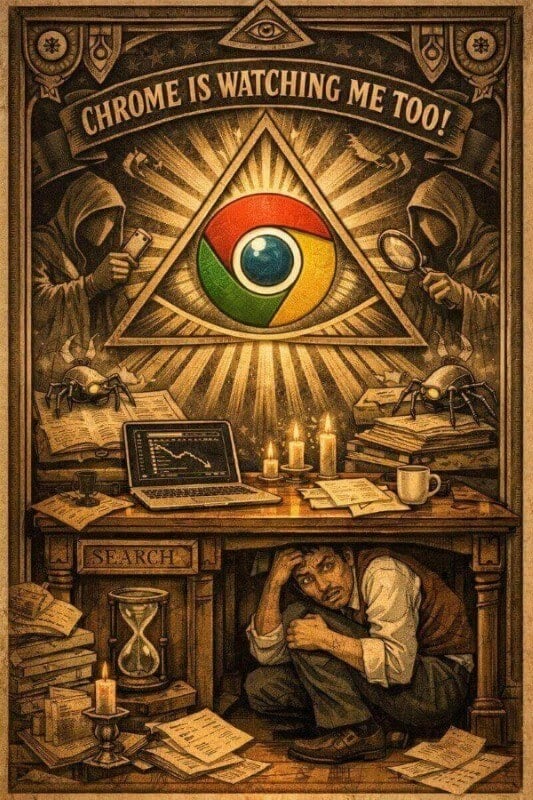
Another old, but gold!
What’s the theory about? The idea is that Google doesn’t rely only on crawlers, links, and content but also uses data from the Chrome browser to influence rankings. Sometimes this idea goes even further: for example, that Google might look at Chrome bookmarks or even listen through microphones to decide which sites deserve higher rankings.
What’s behind it: Publishers notice unusual correlations. For example, when many users visit a site via Chrome and quickly return to the search results (pogo-sticking), rankings seem to drop faster than when similar behavior comes from Safari or Firefox users.
Sceptic’s opinion: Absolutely no way. Dwell time is not a good factor. If a user finds what they’re looking for quickly, that’s success, not failure. Using dwell time would punish sites that solve problems fast. The whole idea exists only because Google could use Chrome data. That’s not evidence, that’s a logical fallacy. If the core behavior signals don’t make sense, then expanding the theory to bookmarks or microphones makes even less sense.
Theory 4: The Niche Site Kill Switch
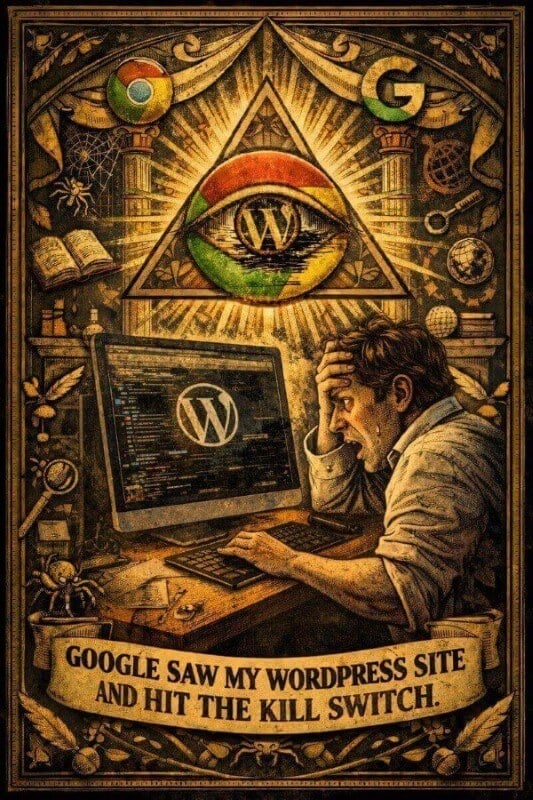
That’s another one that was born after the Google API Leak and HCU updates.
What’s the theory about? Some publishers believe Google has a classifier that labels sites as ‘Made for SEO.’ It supposedly targets sites with a familiar combo: WordPress, popular themes like Astra, affiliate links, and no real company address in the footer. Once enough of these signals stack up, Google hits a kill switch and pushes the site down even if it has perfect content and layout. The idea is that Google wants to get rid of info sites and push Reddit higher to collect better data for AI answers.
What’s behind it? Fun fact: there’s no such thing as a ‘Made for SEO’ label in the leaks. So, we can actually stop right here. But fine, here’s what’s actually found: a bunch of basic signals that look at what kind of site it is, how commercial it appears, whether it looks like an affiliate project, what type of content it publishes, and how much trust the domain has. None of these is a death sentence on its own.
Sceptic’s opinion: People certainly work hard to justify around simple truths. Your site has a terrible UX due to the overwhelming number of ads and requires a spammy-looking button to continue reading on blog posts. The simple and hard truth that you and so many people don’t want to face is that their sites are bad. I don’t care how good the content is when it’s buried in ads. At a minimum, you should reduce them for a couple of months and see if that helps recover the rankings.
Theory 5: The Internet Died Long Ago

Dead Internet Theory (DIT), in its classical form, sounds pretty disturbing: most of the Internet is no longer alive. All the content, comments, likes, and discussions are created by bots and AI, talking to each other. Real users are rare guests, and the Internet is just pretending to be active and live.
This sounds very tinfoil-hat-ish, but SEO specialists have their own – and more down-to-earth version of the DIT.
What’s the theory about? From an SEO point of view, the idea is that the web is slowly turning into a closed loop. AI writes content, search bots index it, other bots scrape it, and more AI rewrites it. Sites are no longer competing for real people, but for the attention of algorithms. Traffic and clicks do exist, but the number of actual humans behind them feels smaller.
What’s behind it? The theory comes from long-time internet users and SEO practitioners who started noticing more and more automation all around. Bots, scrapers, content generators, and ranking algorithms now produce and consume content at a much larger scale than humans. Over time, this created the feeling that the web is talking to itself.
Sceptic’s opinion: It’s not really a dead internet as much as it is a spam internet. People have been pumping out low-quality, spun, and now AI-generated content for a very long time. Humans are still good enough at detecting humans, so most people don’t spend much time engaging with that spam anyway.
To Sum Up
These aren’t facts. These are patterns people keep noticing, and Google never really explains. The theories help people make sense of a web that suddenly stopped working the way it used to. It’s easier to believe that a cold corporate machine is working against you than to accept that the old ‘write simple articles and rank’ model is gone.
Still… when bots write for bots, AI answers replace clicks, and real users quietly disappear from analytics, you can’t help but wonder. Maybe the Internet knows something we don’t?