| CMS | SEO Strengths | Notes / Considerations |
|---|---|---|
| WordPress | Strong plugin ecosystem (SEO-plugins, canonical/metadata control), dominant market share (~49% of high-rank domains) | Very broad, many themes/plugins – need to optimise setup. |
| Ghost | Clean codebase, fast performance, minimal overhead | Less plugin-rich for advanced SEO/ad-monetisation. |
| Hygraph | API-first, designed for structured content (good for modern SEO) | More technical. May need setup for full SEO-workflow. |
| Drupal | Built for complex content structures. Good when many content types & users | Technical. Not as plug-&-play as WordPress. |
| Strapi | Full developer control, can optimise SEO output, headless flexibility | Requires dev resources. SEO depends largely on the front-end. |
The 2026 Best CMS Power List: 9 Platforms for Publishers
With 2026 around the corner, you want traffic that pays, not traffic that vibes.
And if you’re serious about turning your audience into income, with ads, affiliates, offers, whatever fuels your revenue, your CMS becomes the engine under the hood. Pick the right one, and you publish faster, rank higher, and monetise harder. Choose the wrong one, and you’re basically duct-taping dollar bills to a sinking ship.
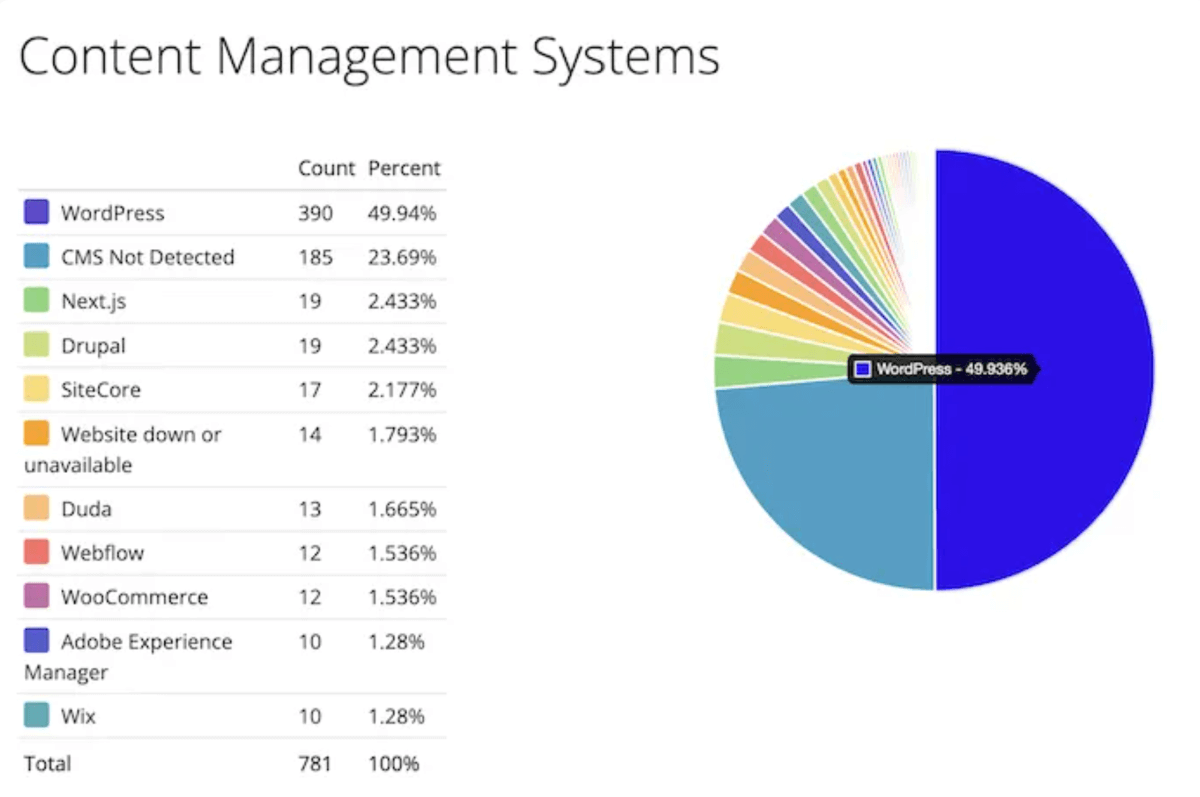
Most Used CMS for SEO; Image Source: rankability.com
An analysis of 59,033 top-ranking domains, showed that 49% used WordPress. But is this really the “best CMS for SEO” and monetization for your website?
Whether you’re after the best CMS for publishers, just top CMS platforms or even the best CMS for small business, SEO or best cms for website monetization you must pick the one that works for you. And not against you.
This guide hands you the best CMS platforms for publishers. And it shows you exactly what’ll make your Monetag setup print money instead of excuses.
How You Choose the Best CMS
When it comes to website, traffic and monetisation you need a specific type of CMS that can properly serve you. So, before you dive into names, you need criteria.
Here’s what you need to check, before committing to a CMS:
- Does the CMS let you control meta tags, canonical URLs & structured data easily?
- Does it allow fast page-loads, good Core Web Vitals, and mobile-first layouts?
- Can you scale, or does it have an easy editorial workflow (especially if you’re publishing often)?
- Does it integrate (or allow integration) with traffic monetisation tools like Monetag and ad networks?
- Does it fit your team size, budget, and future-growth vision?
You must run this check-up before, because the “best CMS software” for a global media brand is different from that for a solo blogger.
Top 9 CMS Platforms For Monetization
There are many CMS available nowadays. From free to more premium versions, you can pick from a lot of this type of service providers.
However, not all are suitable for publishers like you, and especially for monetization. Thinking ahead, we picked several contenders, explaining how they stack up for you:
1. WordPress

Best for: Broad publishing – from solo bloggers to large media brands.
The 2025 guide from WP Engine describes WordPress as the undisputed champion for publishers. Because its “unparalleled flexibility bridges the gap between simplicity and scalability.”
Notes: Massive plugin ecosystem, strong SEO support, and easy monetisation integrations (ads, affiliates). Because it’s so widely used, many monetisation tools, including Monetag plugins/themes, are likely to be available.
2. Ghost

Best for: Clean, content-first publishing workflows – writers, newsletters, lightweight sites.
Ghost is designed specifically for publishers who want speed and simplicity, rather than full CMS heavy features.
Notes: Fast, minimal overhead, good for you if you publish frequently and want fewer distractions. Might have fewer ad- or affiliate-specific plugins than WordPress.
3. Strapi
Best for: Headless publishing, higher scale, multi-channel content delivery.
Strapi is a headless open-source, API-driven CMS built to give developers full control over how content is structured, delivered and displayed.
Offers flexible content models, fast deployment pathways, and the ability to push articles to multiple front-ends (websites, mobile apps, AMP, etc.).
Notes: Gives you developer-level control and flexibility. If you plan to expand beyond web pages (apps, APIs, multi-device) this is strong — but you’ll likely need dev resources.
4. Contentful

Best for: Enterprise-grade headless publishing, teams managing large volumes.
Contentful is a cloud-based, API-first headless content-management system (CMS). It enables teams to model content, manage workflows, and deliver it across websites, mobile apps and other digital channels.
Also, it supports structured content models, REST and GraphQL APIs, and is designed for flexibility and scalability in multi-channel publishing.
Notes: High tech, strong future-proofing. Monetisation works but may require more custom setup.
5. Hygraph (formerly GraphCMS)
Best for: Structured content workflows, hybrid/headless publishing, editorial teams.
Hygraph is a headless, API-first CMS built for complex content workflows and multi-channel delivery.
Notes: Excellent if you need to scale and extend beyond a simple blog. Could be overkill if you’re just getting started.
6. Drupal

Best for: Organisations needing extensive content modelling, custom user roles, scalability, and strong security.
Drupal is a robust open-source CMS aimed at complex websites and enterprise workflows.
Notes: Steeper learning curve, requiring more technical resources. If you’ll monetise traffic heavily, the infrastructure is there. Just ensure you have support.
7. Joomla
Best for: Websites that need more control than very lightweight CMSs, with multilingual functionality or community features.
Joomla is an open-source CMS suitable for medium-sized sites or users with some technical ability.
Notes: Might not be as SEO-oriented or plugin-rich as WordPress for monetisation out of the box. However, it’s suitable if you have a moderate scale and want flexibility.
8. TYPO3
Best for: Large organisations, multilingual portals, highly custom publishing workflows that demand high flexibility.
TYPO3 is an enterprise-level CMS, designed for large, multilingual, or complex sites where scalability and security matter.
Notes: More specialised and may require tech investment. Good if you’re targeting global audiences or many markets.
9. Newsifier
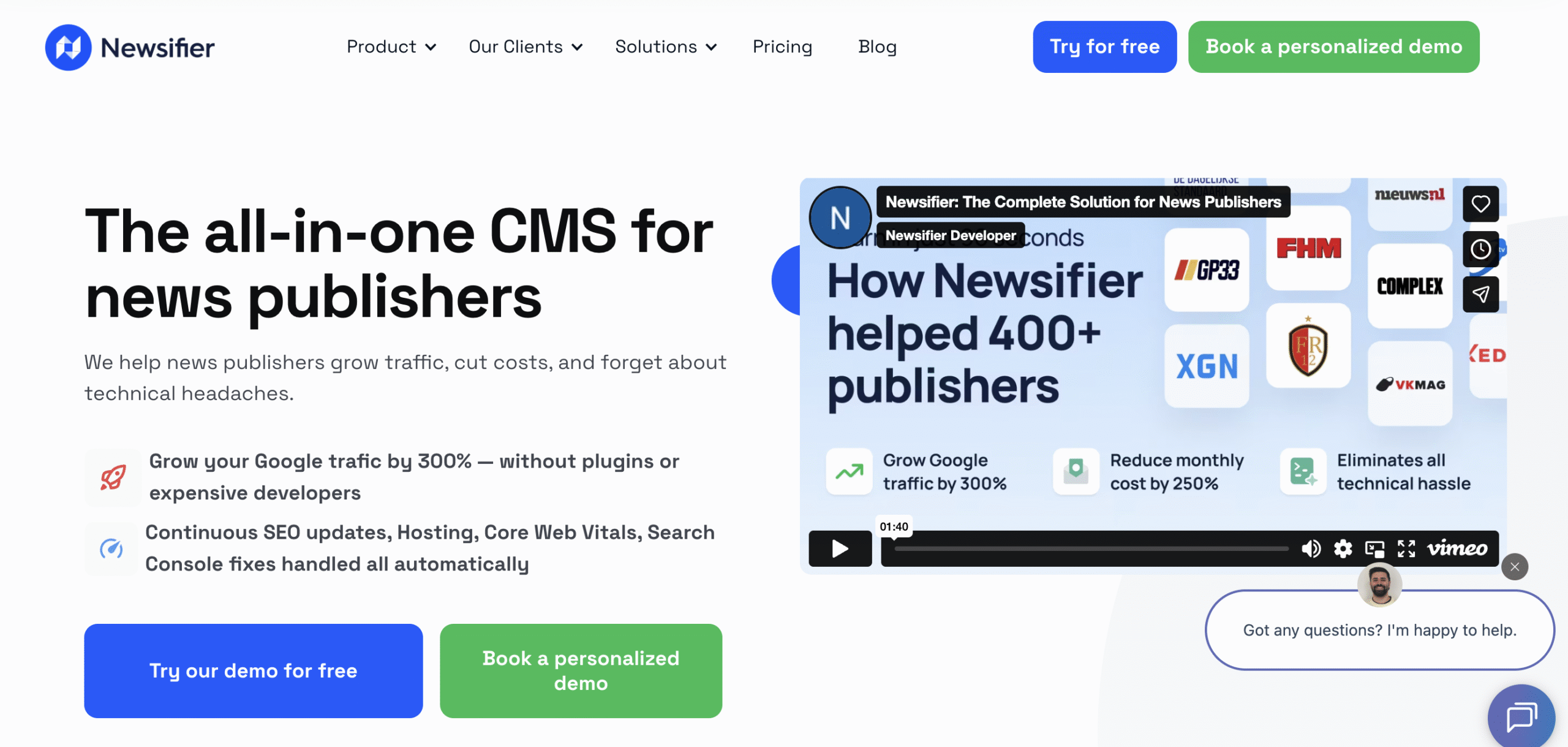
Best for: Sites aimed at high-volume news publishing, Google Discover traffic, editorial automation, and publisher-specific workflows.
Newsifier is a CMS built specifically for news publishers, with built-in tools for editorial workflows, SEO, and traffic growth.
Notes: Great for news publishers. For when your monetisation is based on heavy traffic and ad-driven.
Top Tip
If you’re monetising via ads, subscriptions, or affiliates (with Monetag in mind), you want a CMS that gives you strong SEO, monetisation support, and ease of use.
All of which might point you strongly towards WordPress in most cases. However, looking into Headless CMS is a real game-changer.
And we’ve got just the guide for you! Top Headless CMS for Monetization.
Best CMS for SEO: Comparison Table
Here’s a small comparison across key SEO criteria so you can weigh which CMS aligns best with your traffic-monetisation goals. These options check as best cms seo wise:
Picking & Implementing Your CMS To Boost Revenue
- Map your monetisation model
Are you running display ads, affiliate offers, subscriptions? Make sure your CMS supports easy placement, tracking & optimisation.
- Prioritise SEO fundamentals
Choose a CMS where you can edit title/meta, manage URL structure, add schema markup and load fast. (These translate into more organic traffic you can monetise.)
- Verify plugin/integration support
If you pick WordPress, check Monetag-compatible themes/plugins, ad-management add-ons, and analytics hooks.
- Design for performance and conversion
Fast-loading pages and clear ad/affiliate placement keep users engaged (and earn for you).
- Plan for growth
Start small (choose the best cms for small business), but pick the best cms platforms that are scalable so you won’t be forced into a costly migration later.
Final Verdict: Go With Monetag & Your CMS Of Choice
If you ask “which CMS is best for SEO” or “what’s the best CMS for publishers”, you’ll hear WordPress time and again.
And that’s mostly because it checks all the boxes. It’s SEO-friendly, plugin-rich, scalable, and monetisation-ready.
But if you pair it with Monetag, you’re giving yourself the infrastructure to not only attract traffic. You’re turning it into revenue.
So here’s your action plan: choose your CMS now, integrate Monetag immediately, and start publishing on the spot. Then all that’s left is for you to optimise relentlessly.
Because really, the best CMS software is the one you use profitably. So make yours count.
Whether you want the best cms for seo, best cms for publishers, or top cms platforms, you also want monetisation. Choose a CMS that delivers for traffic and revenue.
Pick wisely. Monetag-ready. SEO-tuned. Growth-focused. Ready to win?